Robert James Russell (aka @robhollywood ) is an inspiring writer, and the newest member of Year Zero Writers. He has just finished taking in the submissions for a fascinating project, unambiguously titled "Sex Scene Anthology". Contributors had to submit a sex scene, disconnected from any context, and preferably not lifted from a longer work, but compiled specifically for this anthology. What's so intriguing is how difficult it is to decontextualise in this way (which, in turn, casts some fascinating light on the (dis)integration of sex in human life), so many of us have ended up creating more of a short story than a scen. Me included, I'm afraid. This is it.
Decided content warning (and not just for erotic content - severely transgressive material)!!!
Her skin’s so tight, I think as she leans on the sideboard with a juice. Stretched on her like a canvas.
I’d paint her with my cum.
I thought the same the first time she showed up in that half shirt, slapped The Birth of Tragedy on the table and said, “So, for Nietzsche, you’re the man.”
The man. The fucking ubermensch all uber those tight fucking tits.
“I guess,” I said, and our Wednesday night ritual began. Tammy got Nietzsche 101. Sarah got a babysitter and the comfort of some father time for Alice while she yogalatesed away her pregnancy fat. And I. I got to score the taut contours of Tammy’s skin on my cortex, storing it away till she left and I sat, still stiff, and closed my eyes, and imagined it on my fingers. On my cock.
We talked about the ubermensch and Tammy said the idea of a superMAN is just ridiculous, everyone knows a man’s will is in his willy and I thought she’s got a point but damn those tits are so fucking pert.
We talked aesthetics and the pursuit of pleasure and by our fifth session we got to wine, and how to blend the senses and how to separate the senses, and I said let me show you, and got out a bottle of ’47 Cheval Blanc and rested it in the cradle of my corkscrew, slowly cranked the angle, and lowered the screw into place, cutting with delicacy and precision to disturb nothing, and let the wine rest and brought her two glasses, and made her drink the first with her eyes closed and said, describe the difference between these different wines.
Two weeks later she caught my glance and she looked straight back and now she says wait here, and I wait and I can feel my body going into contractions each one pushing my cock harder against the cloth and the door opens and she says, watch, and I start to touch myself and she says no, later, separation of the senses, and walks across the room, my eyes following the path of her tits tight beneath her top, and she removes my clothes one by one, and stands and takes off her stockings and ties one around each of my arms, holding me cruciform to the sofa.
She repeats, watch, and I watch her fingers, and I watch her clothes, and I watch her skin, and when she removes the final pieces of lace the contractions through my body are so strong they lift my spine right off the sofa, and I watch the tips of her fingers and the deft circles she makes, and only one finger from the other hand sliding in and my whole body echoes the thought, how fucking tight, and when her body shakes in orgasm there’s not a sound and she leaves a finger, slowly swirling on herself and says, OK, separation of senses, and stands and picks up my shirt and twists it into a rope and walks over there’s one last sight of her tits closing in on my face and I open my mouth, and she leans over and I go blind and feel the pressure on my skull, and then something smooth, and firm, and tight.
See, she says, laughing because see is the one thing I don’t do but fuck I can feel it, and I strain upwards.
One more moment, she says, and there’s nothing, and I wonder if I hear the sound of her footsteps but I can’t be sure and my mouth’s open and my body’s spasming, again and again, and finally, I hear her say, OK, and there are her tits again, circling on my face, a nipple stopping and lingering against my outstretched tongue, and she repeats, OK, and says, now
and lowers her cunt onto me and it’s so fucking tight I explode before she’s fully down, and this time I hear her scream as well, and she sits there, massaging me gently with her cunt till the last ripple has subsided.
There, she says, the pursuit of pleasure, then there’s only the sound of our breathing and she raises herself off me, and there’s silence, and maybe the sound of cloth, and slowly the thought creeps in like a toothache.
What have I done.
As if she reads my mind she says “It’s OK, no one will ever know I was here.”
“Are you sure?”
“Of course I’m sure,” she says calmly, and I feel her untie my hands.
“Sarah,” I say.
“I know, she’ll be back any minute.”
I pull my shirt from my face and she’s in the doorway and she smiles, and slowly pulls up her skirt and I see her cunt glistening at me. “Always remember tonight,” she says, holding it there and I set my brain to burn the image in my hard drive, and she flattens her skirt down and smiles again, and I look around and
Oh Jesus fuck.
Alice, I think, seeing the swaddling on the floor, and her small, pale feet. “You let Alice see that?” I say, and she’s motionless.
And then I see the wine cradle, the metal of the screw stained dark. “You’ve been drinking my goddamn wine?”
Guilt. And anger.
I look again. Not just liquid. Deep, coagulated drops, and something. Not cork. Something.
Stickier. Messier.
Alice. Motionless. Alice’s head peeking out from the cloth. A dark, coagulated stain. Something sticky seeping from the top of Alice’s head.
The metal of the wine screw dark.
My balls still aching.
“Like I told you,” says Tammy from the door, “no one will ever know I was ever here.”
Showing posts with label Year Zero Writers. Show all posts
Showing posts with label Year Zero Writers. Show all posts
Wednesday, 11 August 2010

Friday, 30 July 2010
The Honesty of Bodies
My WIP has been a troublesome, tricksy beast. Originally going by the title A Life Drawn Freehand, it started as a tale of a grieving 50-something mother comng to terms with her grief by pursuing the career she put on hold in her 20s. I have struggled and struggled with the voice but I finaly think I have it, in the context of a very different story, but one with the same heart, the relationship of mutual discovery between an older woman and younger man.
This is the new chapter one. The book is now called The Honesty of Bodies, from a line in the beautiful poem of Kirsty Logan's, Ways of Making Love.
It should probably come with a content warning - but you probably all know that by now :)
--
“It’s not like I’m not hungry,” she says. “I just can’t eat. It’s like eating is a memory my body knows it has but can’t ever reach.”
A distant memory, I think, looking at her. She has so little energy her head’s just lolling back in the pillow and she can’t even look at me. Not that it matters, I guess. I shift in front of the sun coming in the window and her eyes are unresponsive. She’s shutting down.
“And I don’t even know if I want to remember. You know?”
“Yeah.”
“No you don’t.”
“I guess not.”
“I keep trying to figure it out.” Her speech is slow now, and she’s not looking at me and she’s not looking at the ceiling and she’s not looking anywhere else, so I find it hard to place the words at all. “This thing. This whatever it is that made me forget how to eat. Where did it come from?”
“Who knows,” I say, but the question’s not for me.
“I just don’t know. Am I killing myself? Or is someone, some thing doing this to me? Or did I just get sick?”
Her breathing’s as loud as her words by now. I look at her chest to see the rise and fall but there’s nothing there.
Eventually she says, “Kiss me.”
I bend over and press my lips to hers, leave them there a second, and pull away, half expecting the room to be silent when I do.
“That was nice,” she says. “I always thought it would be.” She runs the tip of her tongue around her mouth and I think I see a movement in her throat.
“You thought about us kissing?”
But she’s already somewhere else.
Lifting her into the chair is so easy, even though I haven’t worked out in months. I fix the drip like I was shown, and wheel her down the ward.
“Just getting some air,” I say to a nurse, who smiles back at us.
I put her in the front of the car, leaving the drip and the chair, pop a couple of warfarin, and take her back to mine. She’s still alive when I place her in the bath, because it’s been an hour now and she feels as warm as the water I’ve run for her. I wash the smell of hospital from her skin, dry her down, and smooth oil on her and in her, leaving it slick on the surface of her sores.
The silk falls over her and she’s so slippery I make sure I have a good hold of her as I carry her downstairs, and back into the car.
We’re driving for half an hour and I haven’t heard anything from her since she left her bed. I don’t carry her far from the car. The trees are tight and the summer growth is thick.
The silk slides off her as easily as it slid on, and in the sun, Bella’s skin, her whole body, is almost transparent. And cool, even in the heat; my hands warm the oil and its scent merges with that of the leaves. The light tricks me and for a moment I think she’s becoming solid, like she’s drawing the sap into her.
I remove my clothes slowly, and lie on top of her, and even when I come the only sound is the grass underneath us.
I lie beside her, reach out, feel the cloth, and take out the blade. I slide it through the skin on each of her arms, leaving lines of red that seem to rise and then hover, the fluid as still as the summer day.
I draw the same lines on my own arms and watch as the warfarin pushes my blood.
I take Bella’s hand and lay my head on the forest floor, and I wonder if the scent of blood will draw foxes or badgers before the insects come, or maybe someone will follow their dog through the undergrowth, or maybe a gamekeeper tracking his gundog after a kill, or maybe Julie.
Maybe Julie.
This is the new chapter one. The book is now called The Honesty of Bodies, from a line in the beautiful poem of Kirsty Logan's, Ways of Making Love.
It should probably come with a content warning - but you probably all know that by now :)
--
“It’s not like I’m not hungry,” she says. “I just can’t eat. It’s like eating is a memory my body knows it has but can’t ever reach.”
A distant memory, I think, looking at her. She has so little energy her head’s just lolling back in the pillow and she can’t even look at me. Not that it matters, I guess. I shift in front of the sun coming in the window and her eyes are unresponsive. She’s shutting down.
“And I don’t even know if I want to remember. You know?”
“Yeah.”
“No you don’t.”
“I guess not.”
“I keep trying to figure it out.” Her speech is slow now, and she’s not looking at me and she’s not looking at the ceiling and she’s not looking anywhere else, so I find it hard to place the words at all. “This thing. This whatever it is that made me forget how to eat. Where did it come from?”
“Who knows,” I say, but the question’s not for me.
“I just don’t know. Am I killing myself? Or is someone, some thing doing this to me? Or did I just get sick?”
Her breathing’s as loud as her words by now. I look at her chest to see the rise and fall but there’s nothing there.
Eventually she says, “Kiss me.”
I bend over and press my lips to hers, leave them there a second, and pull away, half expecting the room to be silent when I do.
“That was nice,” she says. “I always thought it would be.” She runs the tip of her tongue around her mouth and I think I see a movement in her throat.
“You thought about us kissing?”
But she’s already somewhere else.
Lifting her into the chair is so easy, even though I haven’t worked out in months. I fix the drip like I was shown, and wheel her down the ward.
“Just getting some air,” I say to a nurse, who smiles back at us.
I put her in the front of the car, leaving the drip and the chair, pop a couple of warfarin, and take her back to mine. She’s still alive when I place her in the bath, because it’s been an hour now and she feels as warm as the water I’ve run for her. I wash the smell of hospital from her skin, dry her down, and smooth oil on her and in her, leaving it slick on the surface of her sores.
The silk falls over her and she’s so slippery I make sure I have a good hold of her as I carry her downstairs, and back into the car.
We’re driving for half an hour and I haven’t heard anything from her since she left her bed. I don’t carry her far from the car. The trees are tight and the summer growth is thick.
The silk slides off her as easily as it slid on, and in the sun, Bella’s skin, her whole body, is almost transparent. And cool, even in the heat; my hands warm the oil and its scent merges with that of the leaves. The light tricks me and for a moment I think she’s becoming solid, like she’s drawing the sap into her.
I remove my clothes slowly, and lie on top of her, and even when I come the only sound is the grass underneath us.
I lie beside her, reach out, feel the cloth, and take out the blade. I slide it through the skin on each of her arms, leaving lines of red that seem to rise and then hover, the fluid as still as the summer day.
I draw the same lines on my own arms and watch as the warfarin pushes my blood.
I take Bella’s hand and lay my head on the forest floor, and I wonder if the scent of blood will draw foxes or badgers before the insects come, or maybe someone will follow their dog through the undergrowth, or maybe a gamekeeper tracking his gundog after a kill, or maybe Julie.
Maybe Julie.
Wednesday, 23 June 2010
Beautiful Things That Happen to Ugly People

It's several months and considerably different weather ago since we launched the Year Zero Live tour at Rough Trade East. Now, we are coming to the tour's grand finale at another fantastic music venue, The Good Ship in Kilburn.
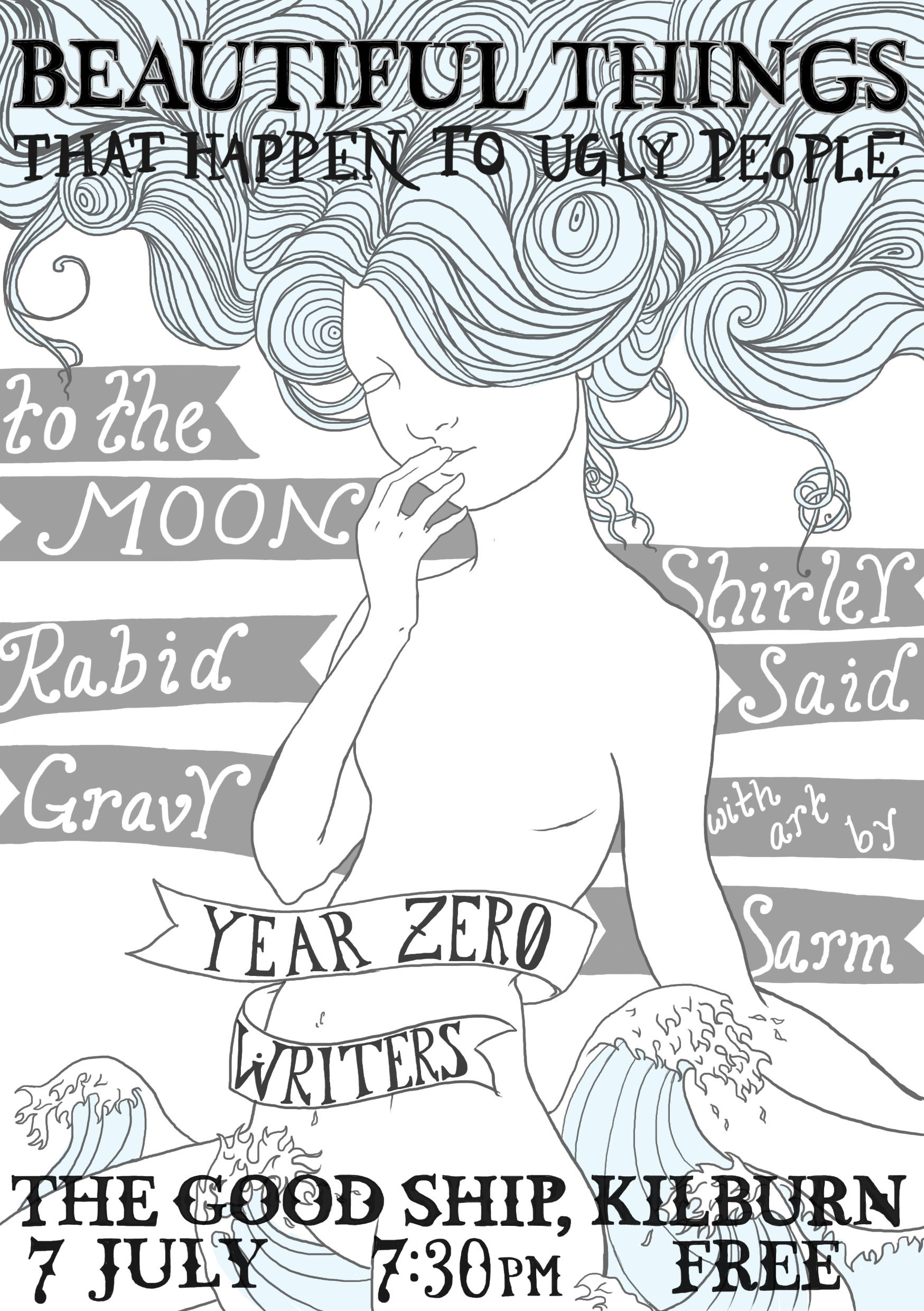

The event Berautiful Things that Happen to Ugly People brings together readings, music, and art, looking at those oases of beauty that spring up like unkillable weeds in even the most arid of lives. And hoping to be such a moment for everyone there. That stunning poster art is by Sarah E Melville, whose extraordinary moedern illuminated manuscript Beautiful Things that Happen to Ugly People is the centrepiece of the evening. You can also enjoy it forever on a commemorative T-shirt.
and we are delighted to welcome as our very special guest top London poet Becca Fenton
Becca Fenton likes words and playing with sounds and likes you too, for coming to listen to hers. She used to run the 'wordPLAY' spoken word night at The Good Ship and is very excited about the current spoken word and new writing scene in the UK. her favourite cheese in Lincolnshire Poacher and her favourite film is Truly Madly Deeply.
Art by Sarm
Featuring the international launch of the books:
Beautiful Things that Happen to Ugly People by Sarah E Melville
(life:) razorblades included by Dan Holloway
Thursday, 13 May 2010
Lilith Burning


Lilith Burning: Perceptions, Reflections and Deceptions of the Eternal Infernal Feminine
Katelan V Foisy from New York’s Knickerbocker Circus is coming to the UK, and will be joining forces with Year Zero Writers for a set at the Literature Lounge, one of London’s top literary nights at The Covent Garden Poetry Cafe, on May 20. The day before she’s coming to Oxford for a pop-up show on society’s malleable and porous perceptions of the feminine, taking to the streets with me, a voice recorder and a camera to capture the thoughts of the people of Oxford, out of which some kind of installation will take shape, to be shown that night at The Albion Beatnik Bookstore, where we will be reading our own wokr on the subject, along with that of Daisy Anne Gree.
Thursday, 18 February 2010
Freakshow
I lie
Lip-reading the liquid crystal drumbeat.
Red slashes strafe the ceiling;
Hours minutes seconds,
The tick tock triptych
Flickers faces of a pulsebeat promenade,
A pageant scarred
From the egg-pan scraps and rancid lard
Of my life.
One by one they hide their whispers in the roar,
The crowdsourced maw
The thousand mouths
That pound and gouge
Their silent cries
Inside my skull,
Behind my eyes,
Repeating
Repeating
Repeating, repeating:
Freakshow.
Freakshow plays a nightly Columbine zoetrope tamazepam blur, rejubilant slur, infinite whir, sleep now bullet-hole smack-rush joy lie there the deserving dead and never stir
Freakshow wears a wrist-slit wristlet of his meds, rosary recites and plucks each bead and tongues each name, each holy mother treat me beat me amen
Freakshow has fuck-dream fantasies of Mary Bell, folds her in a skin book blanket to protect her from a living hell
Freakshow prowls the corners of the pheromone cage he constructed in his own front room
Freakshow says if you don’t see the secrets of Gannymede, pulsars, galaxy dust beginnings striated out in Jack White’s riffs then what’s the point, and mashes grandma’s pumpkin chowder cool between air guitar fingers
Freakshow’s life is so important to your lace chintz gimp mask vibrator conscience you waterboard torture throttle each word before it leaves his throat
Freakshow finds stillness in the million iPod ears scrumming a chaos concertina; in the neon thrum the bass and drum, the car horn and hawker, the cortisol scent of slickers bonus-bent and rent boys, hookers, a thousand faces more lost than his in cardboard houses, peeking out from Prada blouses, empty, drawn, transparent, barely bulging the bubble of his self-absorption as they brush by towards their Waterloo nothing
Freakshow harvests cancer daydream sinews, tans and tenderises, chemo anaesthetises them with his keypad club till each page hollers at the star-pricked unpolluted sky grazing the night for kitten candy innocents to scrape, for stopped-up pelmet ears to rape
Freakshow needs a passport to leave the prison of his head, increasingly infrequently collects his border guard refusal stamps and shuffles back to his squalid camp to wait his patient turn
Freakshow lives in a candle joint hotel room darkness world, shrinking down to the wrinkled dragons beyond the body boundary of his collagen-culled and crippled skin
This sicked-on Soho sidewalk night slithers toward amaretto coffee dawn, turns off the torture porn of spooling self-derision, the prophecies, the visions, the pharmacy and fallout from a fissile life, and bares its wrists to the drab diazepam day,
The lithium grey
The fog, the fug, the cigarette-smoke grey
The sacred grey
The damnèd grey
This daylight veil
I wear like dust
This calico skin I push through the pores from an endlessly replenishing stuffcloth innards mind
Is me
I’m
Your border control, your lintel lychgate ash-filled heart
The skin that shrink wraps and vacuum packs you
The barcode that tracks you
The pudenda the sphincter that sucks in your boredom excretia
The white sand shore that laps on your drabness
That traps the flab and flaccid slab of your normality.
I’m the cock, the gash
The pox the rash
The stenching slash to your screaming throat, your pleading bleeding hands that wrote their foul graffiti on the wall, the great stone empty hall;
The echoes in your ears, the reflections in your tears, the flea bite fingers that pricktease your skin for eighty seven years
Repeating
Repeating
Repeating, repeating
Freakshow.
Lip-reading the liquid crystal drumbeat.
Red slashes strafe the ceiling;
Hours minutes seconds,
The tick tock triptych
Flickers faces of a pulsebeat promenade,
A pageant scarred
From the egg-pan scraps and rancid lard
Of my life.
One by one they hide their whispers in the roar,
The crowdsourced maw
The thousand mouths
That pound and gouge
Their silent cries
Inside my skull,
Behind my eyes,
Repeating
Repeating
Repeating, repeating:
Freakshow.
Freakshow plays a nightly Columbine zoetrope tamazepam blur, rejubilant slur, infinite whir, sleep now bullet-hole smack-rush joy lie there the deserving dead and never stir
Freakshow wears a wrist-slit wristlet of his meds, rosary recites and plucks each bead and tongues each name, each holy mother treat me beat me amen
Freakshow has fuck-dream fantasies of Mary Bell, folds her in a skin book blanket to protect her from a living hell
Freakshow prowls the corners of the pheromone cage he constructed in his own front room
Freakshow says if you don’t see the secrets of Gannymede, pulsars, galaxy dust beginnings striated out in Jack White’s riffs then what’s the point, and mashes grandma’s pumpkin chowder cool between air guitar fingers
Freakshow’s life is so important to your lace chintz gimp mask vibrator conscience you waterboard torture throttle each word before it leaves his throat
Freakshow finds stillness in the million iPod ears scrumming a chaos concertina; in the neon thrum the bass and drum, the car horn and hawker, the cortisol scent of slickers bonus-bent and rent boys, hookers, a thousand faces more lost than his in cardboard houses, peeking out from Prada blouses, empty, drawn, transparent, barely bulging the bubble of his self-absorption as they brush by towards their Waterloo nothing
Freakshow harvests cancer daydream sinews, tans and tenderises, chemo anaesthetises them with his keypad club till each page hollers at the star-pricked unpolluted sky grazing the night for kitten candy innocents to scrape, for stopped-up pelmet ears to rape
Freakshow needs a passport to leave the prison of his head, increasingly infrequently collects his border guard refusal stamps and shuffles back to his squalid camp to wait his patient turn
Freakshow lives in a candle joint hotel room darkness world, shrinking down to the wrinkled dragons beyond the body boundary of his collagen-culled and crippled skin
This sicked-on Soho sidewalk night slithers toward amaretto coffee dawn, turns off the torture porn of spooling self-derision, the prophecies, the visions, the pharmacy and fallout from a fissile life, and bares its wrists to the drab diazepam day,
The lithium grey
The fog, the fug, the cigarette-smoke grey
The sacred grey
The damnèd grey
This daylight veil
I wear like dust
This calico skin I push through the pores from an endlessly replenishing stuffcloth innards mind
Is me
I’m
Your border control, your lintel lychgate ash-filled heart
The skin that shrink wraps and vacuum packs you
The barcode that tracks you
The pudenda the sphincter that sucks in your boredom excretia
The white sand shore that laps on your drabness
That traps the flab and flaccid slab of your normality.
I’m the cock, the gash
The pox the rash
The stenching slash to your screaming throat, your pleading bleeding hands that wrote their foul graffiti on the wall, the great stone empty hall;
The echoes in your ears, the reflections in your tears, the flea bite fingers that pricktease your skin for eighty seven years
Repeating
Repeating
Repeating, repeating
Freakshow.
Thursday, 4 February 2010
Year Zero Live - Today!


OK, so tonight’s when we kick off our tour of live readings. Seems like only yesterday we were having a casual joke & speculating some live events might be fun – and here we are!!
6pm – 8.30pm, Rough Trade Records (East), Brick Lane, London TONIGHT
To recap, we have the following on offer:
5 writers
Penny Goring reading Bone Dust Disco
Marc Nash reading Twin Topiary Tales
Larry Harrison reading from Glimpses of a Floating World
me reading SKIN BOOK
Daisy Anne Gree reading the Death and Birth of Johnny the Baptist
3 amazing musical acts
To The Moon
Jessie Grace
InLight
Marc Nash reading Twin Topiary Tales
Larry Harrison reading from Glimpses of a Floating World
me reading SKIN BOOK
Daisy Anne Gree reading the Death and Birth of Johnny the Baptist
3 amazing musical acts
To The Moon
Jessie Grace
InLight
And a whole load of super booky, CD, merch stuff, a smattering of which you can see above
Friday, 22 January 2010
Banned Books
Many apologies. This is a pluggy thread. Apologies also for the fact it contains largely the same material as I posted on the Year Zero site yesterday. But I wanted to tell everyone because I'm excited. Actually I'm more than excited. On February 4th, at rough Trade Records, Brick Lane, London, 6-8.30pm, the Year Zero Live tour begins. Full details here on our website. There are so many reasons I'm excited I don't know where to start. So I'll start with the big news: Daisy Anne Gree's "Hearing Voices" event teaser is out, and here it is!
But before you watch it, I should explain the other big news, which is that only a few hours after we'd posted the video, Facebook had had it reported and were banning it from being posted any more. Why we can't quite tell. We think it may be because Daisy's voiceover touches on a suicide attempt. Sure, the first reaction is COOL! WE GOT BANNED! But the second reaction is what the hell kind of sick world do we live in where we get banned for being open about a mental health issue when Facebook allows all kinds of bilious groups to proliferate. Let's just say, it's given us blog material.
Anyway, make your own mind up - but be warned, I guess. If you like it, do tell other people to watch it. I think it's one of the coolest book trailers out there.
Hearing Voices (link to YouTube video)
That's the two of us reading, by the way. So we have a trailer. And we have one of the coolest tour posters on the planet, courtesy Sarah E Melville, based on the cover for Thirteen Shadows Waiting for Sunrise, the anthology we're touring.

We also have a confirmed second date: 23rd February at To Hell With Books in Woburn Place. And the Oxford event will be held during the Oxford Literary Festival - 20-28 March. And we have notice that Jenn is going to be reading in New York in February too!
So what can you expect if you come along to Rough Trade?
Well, the whole gig is FREE, for which you get:
5 writers
Penny Goring reading Bone Dust Disco
Marc Nash readnig Twin Topiary Tales
Larry Harrison reading from Glimpses of a Floating World
Daisy Anne Gree reading the Death and Birth of Johnny the Baptist
3 amazing musical acts
You'll also be able to buy a whole load of books and CDs and Year Zero merch, any and all of which we will sign.
Most of all, I'm excited because we get to perform together, and in a few cases meet each other for the first time!! And I'm hoping we'll get to meet some of you!
Thursday, 14 January 2010
Countdown: 2 weeks till SKIN BOOK goes on sale

You may have been following my latest project, SKIN BOOK, over at Year Zero. Probably you haven't been :) Anyway, you can read it all for free over there, but if you want a little something in your hands, complete with artwork and design by the amazing Sarah E Melville, there's only two weeks to wait.
The hard copy of SKIN BOOK will not be a standard paperback - that just wouldn't fit the book. It will consist of 8 double-sided high quality cards, of A6 (5.5" x 4.5") size, punched and threaded on a bootlace - like a lanyard programme you'd get at a festival - only bootlaces go with the feel better than lanyards. Price will be under £5 + postage if you order online, or less postage if you buy direct from our live gigs - such as the event at Rough Trade Records, Brick Lane on Feb 4th at 6pm.
SKIN BOOK is a prose poem, first performed in full at Free-e-day live on December 1st. It tells the story of a woman, never touched by another living human, who writes her lonely memories in her SKIN BOOK, her diary made of human skin. And her love for a man who spends his days stalking strangers on the subway, women he can never touch.
Above, you can see Sarah's amazing cover. Which you can have hand tinted in red or not according to taste (but no extra expense). Below you'll see chapter 1. There are also three exclusive, full-page art pieces by Sarah. I hope it's the kind of collectors' edition that you'll consider worth spenidng a fiver on.

Friday, 18 December 2009
Our Second Anthology is out and it's FREE

We've done it!! After an amazing, rollercoaster ride of a buzzing exciting year, we've got a second anthology out. It's only ever going to be available as an ebook BUT in the new year you can buy posters, T-shirts, and come and see us perform live!
Thirteen Shadows Waiting for Sunrise is the second anthology from Year Zero Writers.
It is available in all eformats from smashwords for download HERE. It is also available as a Bookbuzzr, an amazing widget you can embed in your social media and read on screen like a real book. You can also download it as a glorious full colour pdf HERE or by clicking on the cover image.
Follow the #13shadows hashtag on twitter
Thirteen Shadows Waiting for Sunrise represents our individual responses to the simple question: can a writer evoke a reader’s deepest, most personal pain with words? The answers are sometimes brutal, sometimes gentle, sometimes intimate, sometimes universal; they come with smiling faces and with grimaces, promising agony and delight. But they come with a single purpose: to reach inside you.
The whole of my new flashnovel SKIN BOOK is included, alongside many works by better writers.
Do come and see five of us (Penny Goring, Daisy Anne Gree, Larry Harrison, Marc Nash, me) LIVE at Rough Trade Records, 4th Feb at 6pm - complete with 3 amazing musical acts - InLight, Jessie Grace, and To the Moon
Wednesday, 9 December 2009
This is a "Thirteen Shadows Waiting for Sunrise" Teaser
Thank you to those of you who stopped by to see Sarah E Melville's stunning cover art for the half hour it was here. Information about the Thirteen Shadows book and tour will be available on Friday from the Year Zero website
Thursday, 3 December 2009
Free-e-day live

Free-e-day live was the real-life gig to tie in with Free-e-day, the global online celebraion of internet culture that I dreamt up on the bus one afternoon and ended up attracting 100 participants all offering amazing creative things for free, and giving us workshops and webchats with invaluable resources for anyone outside the mainstream. It has been all a bit of a wonderful haze.
Free-e-day live was put together by local singer-songwriter Nikki Loy (pictured) who, being an illustrator as well as musician, embraced the multi-arts idea behind the festival. Held at Oxford's Cafe Tarifa, the night featured an art ecxhibition, belly dancers dressed as skeletons, music and reading. It was a fantastic night with a fantastic crowd. Let me bore you with a LITTLE about what makes a live, indie occasion like this great.
First off there's the hyper-contrived shot for the local rag (who thought, for some reason, that we were giving away electronic gadgets and wanted Nikki and I to hold up some mobile phobnes for the photoshoot!). next there's the inevitable when you invite people from London. As the 8 o'clock kick-off approached, 2 writers and the headline band remained, as so many before them, and so man y, I dare say, to come, stranded on the M40. Never have I been so pleased (I'm always pleased to see him, but I can't remember physically bear-hugging him before) to see Roland (pictured left), who gave us a brilliant rendition of Chapter 17 of The Beach Beneath the Pavement. Hearing his words somehow made them even funnier than they had been on the page, a reminder that stories - whatever your age and their genre - are best read aloud.
 y, I dare say, to come, stranded on the M40. Never have I been so pleased (I'm always pleased to see him, but I can't remember physically bear-hugging him before) to see Roland (pictured left), who gave us a brilliant rendition of Chapter 17 of The Beach Beneath the Pavement. Hearing his words somehow made them even funnier than they had been on the page, a reminder that stories - whatever your age and their genre - are best read aloud.
Setting the reader-musician rhythm we were next treated to a rather endearing keyboard and vocals set from the big-voiced Mol Hodge. "Most of  my songs are a bit morbid" she told us nervously. "Bloody hell, if you think that's morbid just wait for SKIN BOOK" I thought. Mol has a great voice, and plenty of time on her side, and as she explores the melodic range of her music over the years to come is sure to be someone we see more of.
 my songs are a bit morbid" she told us nervously. "Bloody hell, if you think that's morbid just wait for SKIN BOOK" I thought. Mol has a great voice, and plenty of time on her side, and as she explores the melodic range of her music over the years to come is sure to be someone we see more of.
Nikesh Shukla is someone the world has already seen plenty of. With a string of TV and radio credits, festival appearances, awards and the like, he is far the most advanced and successful of any of ourt artists on the night, and we were hideous lucky to snag him - not only that he doled out copies of his kidologies CD to grateful audience members. Having introduced Nikesh as a poet he proceeded to read us a short story, but th e performance element of Rap Tracks - a hilarious tale of pre-teen rap, Asian grandmothers and Gujurati dialect - was the match of anything slam poetry can offer. More confirmation that anyone who says writers can't engage an audience with prose is talking nonsense.
 e performance element of Rap Tracks - a hilarious tale of pre-teen rap, Asian grandmothers and Gujurati dialect - was the match of anything slam poetry can offer. More confirmation that anyone who says writers can't engage an audience with prose is talking nonsense.
I met Nikki Loy, who came on as Nikesh departed back for the next of 20 gigs in 32 days, when she was busking on Oxford's St Giles. I was so taken with her guitar and vocals I snaffled a card and dropped her an e-mail, and I've been impressed with her ebergy, verve, and all-round artistic enthusiasm ever since. This was the first time I've seen her live, and I was impressed by the way she handles a crowd and the way she handles a guitar. She too had freebie CDs that were gobbled up gladly.
In the interval, N ikki came up to me and said "can you hold this?" pointing to a UV tube. "Er, OK" I said rather confusedly, until I saw what was coming next, a train of skeletons snaking to the stage who proceeded to shake their fluorescent booty to music I was too gobsmacked to notice much but think may have been some scuzzy Goldfrapp.
 ikki came up to me and said "can you hold this?" pointing to a UV tube. "Er, OK" I said rather confusedly, until I saw what was coming next, a train of skeletons snaking to the stage who proceeded to shake their fluorescent booty to music I was too gobsmacked to notice much but think may have been some scuzzy Goldfrapp.
 The Scary Skele-belly Dancers gave me the perfect segue into the world premiere of the whole of SKIN BOOK - you know "those were th bones, now for some skin" - ah the joys of improv! Won't say much about me (below). That would be rude. Suffice to say my opinion remains unchanged - performing to a live audience is THE best thing a writer can do - feeling attentive eyes, listening to the gasps the sighs - that kind of engagement is what writing is all about. I THINK people enjoyed it - if enjoy is the right word for a story about a woman whose diary is made from skin she harvested from her twin bro.

The headline act seemed to enjoy it, though, which was nice. The Joker and The Thief describe themselves as a folk blues combo which had me worried before the show. I dislike folk so much I wouldn't hand a picture of Fleet Foxes to my dartboard because it would be unfair to the bristles. But The Joker and the Thief were an unexpected delight. Full of energy (proper energy - the kind you actually believe might just come from some kind of dark passionate place rather than the gurning wurzelly cheeriness of much folk), they delivered a set that was variegated and exciting. They have a penchant for playing around with different instruments, whcih added colour to the set - from frontman Dan (sounds like an epithet from Total Wipeouut) banging the cymbals with an assortment
 of bells and sticks, to Josh's alternation of ukelele, sax and accordian (far my favourite - I could almost feel myself on the set of Amelie).
 A pretty much perfect night was rounded off when two of the skele-bellies came back dressed in burlesque and the crowd dispersed happily into the night.
There seem to be some obvious lessons from a night like this. Everyone would do well to bear them in mind:
1. There is a ridiculous wealth of talent outside the mainstream.
2. The creative world is full of almost boundless energy, enthusiasm, and can-do attitude.
3. Writers are every bit as engaging as musicians.
Here's hoping this is the first of very many such nights I get the pleasure of being involved in. A HUGE thanks to all who contributed, to Cafe Tarifa for being such great hosts, and most of all to Nikki for making it happen.
A full list of artists who contributed to the exhibition:
Cheryl Pearce – Poet
cherylpearce@yahoo.com
cherylpearce@yahoo.com
James Whayman
– Photographer
http://www.unformedmind.com/
Sarah Kennedy – Artist
email: acrylicartist@gmail.com
http://www.sarahkennedyart.com/
Saturday, 7 November 2009
Literature's the new Art: so who's Jay Jopling?
Well, no one's actually said literature is the new art. Apart from me. Most people say it's the new music and they've got a point. Even more people say it's NOT the new music and talk about how literature can't use the gigs & merch model. And they're wrong. About the latter bit, anyway. But what I can't help feeling is that, whilst the music industry is something from which we can learn a lot - about downloads and gigging, and connecting with fans and streamlining businesses; it's actually to the art world we should be looking to understand literature.
I'm always sniping about Goldsmiths and CSM in the 90s and how they were glorified school tie networks, and how the MA Creative Writing from UEA threatened to become the same, but that's not what I mean.
What I mean is this: literature, with a publishing industry on its knees and a load of creative talent chomping to escape the shackles, is shaping up to be the next YBA (Young British artists - Sarah Lucas, Damien Hirst, Tracey Emin, Rachel Whiteread, Michael Landy, Gavin Turk, sam Talyor Wood, The Chapman Brothers, The Wilson Twins et al ad inf).
It's not to do with new tech - not directly, anyway. It's more that I see more and more groups of writers outside the mainstream coming closer and closer to the big time by doing things their way. People like MCM, groups like Jet-Pack and Backword Books, our own beloved Year Zero, salons like Book Club Boutique. Perhaps most groundbreaking in her own way - and you'll laugh at me for saying - Catherine O'Fynn with her mild unassuming "this is just how I did it" approach.
It felt for a little while as though we may have got there a few years ago - as though someone had finally swept Amis and McEwan and Swift out with a broom and replaced them with a hungry new generation of people hungry to put ideas on paper. But A M Homes and Monica Ali and even the Great White Teeth Hope Zadie Smith just got subsumed into the same old same old mainstream. At least Tracey Emin took 20 years to sell out!
So what went wrong with the last generation of new hope? Well, to answer that, take a look at what went right with YBA. If one wants to generalise hideously and lay oneself open to all kinds of loopholes, then one can lay the answer at the feet of two men. And neither was called Saatchi.
What happened for YBA were Jay Jopling and Nick Serota. Curators. Jay Jopling, for those of you of more tender years than me, was the owner of White Cube, the gallery that not only showcased but promoted the work of the fledgeling YBAs. He was the PT Barnum, the - should we rather say - Malcolm MacLaren of YBA - the man who made everytone else think pickled sharks were cool. Nick Serota, of course, was the legendary Tate curator responsible for the Turner Prize.
Curators.
That's what the literary world lacked when White Teeth, Brick Lane, The End of Alice hit the shelves. People who were prepared to take a generation - not just one or two but a wave - and bring them to the public. People who spotted talent, nurtured it, showed it off, and didn't care if there was a place for it in the mainstream - because through force of showmanship and chutzpah they created a parallel and more exciting space.
And that's the big issue the literary sphere faces today if it's going to see all that talent blossom into a golden age, a movement, a new dawn on the public consciousness, a whole fistful of cliches that boil down to one thing: getting the general public talking about books.
Because whether it was marvelling at the brilliance of Whiteread's inside-out house, or spitting disgust at Chris Ofili's dung-filled portraits, Emin's unmade bed, or Hirst's pregnant cow cut in two, the thing Jopling and Serota did was get people talking about art. And not just artworks. A decade or so ago you could walk down a high street in the UK and hear your average Jane and Joe Public discussing what art meant. When was the last time that happened with books? Sure, we talk about vampires or Lost Symbols, but you can't stand at the bus stop and hear people jibe "Ah, but is it literature?"
And that's what we need. We need someone to make the general public talk - with gasps of delight and disgust - about books. About this book and that book and "what is literature?"
So who will it be? You'd think it'd be a publisher, wouldn't you? Vicky Barnsley, maybe, at HC, or Jessica Weiner at Harper Studio, maybe even Scott Pack at Fifth Estate. They're doing good things, all of them. But. Oh but but but.
Maybe the agents then. What about? Well, precisely. Most writers will have heard of Nathan Bransford. Lovely guy. Enthusiastic. And his authors, his individual, exciting, but somehow with a common sense of purpose authors are? Well, precisely (to repeat myself).
So who WILL be the Jay Jopling of the Literary World? Richard Nash, of Soft Skull and Cursor fame, believes it will be him. No, whatever he tells you, he DOES. And he may be right. Maybe.
I'll give a good guess. A good guess is that it'll be one of two people. It'll be a celeb - an Oprah or a Richard & Judy (and you could make a case they've partially done it already, scoff ye not) who says "I'm gonna say f*ck mainstream books. I'm gonna have me a book club and choose me the best most exciting damn books on the planet WHEREVER they come from" and shouts them from the hills. Or it'll be the person who sets up a prize with a million pound pot for the best self-published book of the year (or maybe even the best unsigned ebook - and, by the way, where ARE the ebook only awards? hmmmmmm - and hires a team of rockstars as judges.
Just a guess. And trust me - one of them WILL happen. Within 18 months.
Or it could be one of us.
Now there's a thought.
I'm always sniping about Goldsmiths and CSM in the 90s and how they were glorified school tie networks, and how the MA Creative Writing from UEA threatened to become the same, but that's not what I mean.
What I mean is this: literature, with a publishing industry on its knees and a load of creative talent chomping to escape the shackles, is shaping up to be the next YBA (Young British artists - Sarah Lucas, Damien Hirst, Tracey Emin, Rachel Whiteread, Michael Landy, Gavin Turk, sam Talyor Wood, The Chapman Brothers, The Wilson Twins et al ad inf).
It's not to do with new tech - not directly, anyway. It's more that I see more and more groups of writers outside the mainstream coming closer and closer to the big time by doing things their way. People like MCM, groups like Jet-Pack and Backword Books, our own beloved Year Zero, salons like Book Club Boutique. Perhaps most groundbreaking in her own way - and you'll laugh at me for saying - Catherine O'Fynn with her mild unassuming "this is just how I did it" approach.
It felt for a little while as though we may have got there a few years ago - as though someone had finally swept Amis and McEwan and Swift out with a broom and replaced them with a hungry new generation of people hungry to put ideas on paper. But A M Homes and Monica Ali and even the Great White Teeth Hope Zadie Smith just got subsumed into the same old same old mainstream. At least Tracey Emin took 20 years to sell out!
So what went wrong with the last generation of new hope? Well, to answer that, take a look at what went right with YBA. If one wants to generalise hideously and lay oneself open to all kinds of loopholes, then one can lay the answer at the feet of two men. And neither was called Saatchi.
What happened for YBA were Jay Jopling and Nick Serota. Curators. Jay Jopling, for those of you of more tender years than me, was the owner of White Cube, the gallery that not only showcased but promoted the work of the fledgeling YBAs. He was the PT Barnum, the - should we rather say - Malcolm MacLaren of YBA - the man who made everytone else think pickled sharks were cool. Nick Serota, of course, was the legendary Tate curator responsible for the Turner Prize.
Curators.
That's what the literary world lacked when White Teeth, Brick Lane, The End of Alice hit the shelves. People who were prepared to take a generation - not just one or two but a wave - and bring them to the public. People who spotted talent, nurtured it, showed it off, and didn't care if there was a place for it in the mainstream - because through force of showmanship and chutzpah they created a parallel and more exciting space.
And that's the big issue the literary sphere faces today if it's going to see all that talent blossom into a golden age, a movement, a new dawn on the public consciousness, a whole fistful of cliches that boil down to one thing: getting the general public talking about books.
Because whether it was marvelling at the brilliance of Whiteread's inside-out house, or spitting disgust at Chris Ofili's dung-filled portraits, Emin's unmade bed, or Hirst's pregnant cow cut in two, the thing Jopling and Serota did was get people talking about art. And not just artworks. A decade or so ago you could walk down a high street in the UK and hear your average Jane and Joe Public discussing what art meant. When was the last time that happened with books? Sure, we talk about vampires or Lost Symbols, but you can't stand at the bus stop and hear people jibe "Ah, but is it literature?"
And that's what we need. We need someone to make the general public talk - with gasps of delight and disgust - about books. About this book and that book and "what is literature?"
So who will it be? You'd think it'd be a publisher, wouldn't you? Vicky Barnsley, maybe, at HC, or Jessica Weiner at Harper Studio, maybe even Scott Pack at Fifth Estate. They're doing good things, all of them. But. Oh but but but.
Maybe the agents then. What about? Well, precisely. Most writers will have heard of Nathan Bransford. Lovely guy. Enthusiastic. And his authors, his individual, exciting, but somehow with a common sense of purpose authors are? Well, precisely (to repeat myself).
So who WILL be the Jay Jopling of the Literary World? Richard Nash, of Soft Skull and Cursor fame, believes it will be him. No, whatever he tells you, he DOES. And he may be right. Maybe.
I'll give a good guess. A good guess is that it'll be one of two people. It'll be a celeb - an Oprah or a Richard & Judy (and you could make a case they've partially done it already, scoff ye not) who says "I'm gonna say f*ck mainstream books. I'm gonna have me a book club and choose me the best most exciting damn books on the planet WHEREVER they come from" and shouts them from the hills. Or it'll be the person who sets up a prize with a million pound pot for the best self-published book of the year (or maybe even the best unsigned ebook - and, by the way, where ARE the ebook only awards? hmmmmmm - and hires a team of rockstars as judges.
Just a guess. And trust me - one of them WILL happen. Within 18 months.
Or it could be one of us.
Now there's a thought.
Wednesday, 4 November 2009
Book Launch!
(all photos courtesy and copyright of Janelle McCarty)
I’m always saying that being a writer is about engaging with readers, about getting out and talking to them directly. Which si very easy to do from the safety of one’s keyboard. But last Thursday, it was finally time to put my money where my mouth was, and find out if I felt the same way when I actually had to do some direct conversing with readers. It was time for my book launch.
I’d chosen to hold the launch for Songs from the Other Side of the Wall at The Albion Beatnik bookstore in Oxford for several reasons. First, the owner, Dennis, had agreed to stock my book. Second, it’s the coolest bookstore I’ve ever been in, with its specialities of books on jazz music and the Beat Poets. And third, it’s a perfect venue for hosting not just reading but music.
Because, finding it oh so easy from cyber-safety to say how I didn’t want this to be like any other book launch; I didn’t want a table and some chapters read aloud to polite listeners who’d applaud and maybe buy a signed copy afterwards; I had decided I wanted a gig. A proper gig with live music. Because that’s what my book is about (well, literally, it IS about musicJ); and because that’s what Year Zero is about – giving our readers a great time.
I was very lucky that local singer-songwriter sensation Jessie Grace, whom I’d first heard at Radiohead’s old haunt The Jericho Tavern, said yes, she would play a set from her new album, Asleep on the Good Foot. Throw in some free Tokaji wine (the book is set on a Tokaji vineyard) and I was genuinely excited. When I went into the shop the day before the gig only to find a young guy chopping up Shirley Bassey records to make art, I knew I was in the right place!
Add to all that the fact that Jessie’s producer, Kevin from Selecta Sound, had swung us a 9-strong film crew from Worcester University, and I was in hopping up and down with excitement media tart heaven with anticipation.
It’s hard to figure out what to say about the event itself. It’s not really good form to talk endlessly about yourself, so I’m not going to do a review of the gig. Although I WILL say that Jessie Grace, with her clean, pure voice and dirty guitar, elevated the music part of the evening way beyond anything I could have hoped for.
So what will I talk about? I don’t know. Whether it lived up to my expectations, or whether I decided to shut up and stick behind the keyboard for one. What it was like meeting up with some fellow Year Zero Writers and the lovely Bee Drunken for two. How it felt seeing my boss walk through the door just as I was getting to the juicy bit of a sex scene? Maybe not.
The day itself felt like I’d set up an Authorworld theme park ride. I went from buzz to despair to being physically ill to control-freakery to having, ultimately, the time of my life. I decided went I chose the venue and asked Jessie to play that I didn’t want to play safe. And that had always seemed like the right thing. At Year Zero, after all, we don’t do safe. We do different and exciting and out there for the audience. Come the morning, however, the decision to augment my readings from the book with an impromptu talk about French cinema (I still haven’t quite figured that one out), and a reading of the first three parts of SKIN BOOK, seemed like a Very Bad Idea. Not just because, frankly, saying “Is it wrong to want your snot-piss-shit-come-vomit on my skin?” in front of work colleagues is embarrassing/apt to get you fired. But because SKIN BOOK is my attempt to reach into the darkest parts of the psyche, and to do it justice I was going to have to lay myself absolutely bare. It took several twitter-buddies more effort than I had any right to expect to tweet me up from the depths.
By the time I arrived, though, a can or two of Relentless later (because everyone knows caffeine’s great for anxiety), all I was thinking about was making sure the performance was as good as I could get it. That meant laying the venue out perfectly, sorting out glasses and wine, and laying out the souvenir programmes. Best of all, though (for me, not for them), having three cameras, with an editing suite in the basement meant I had enough to focus on getting my positioning and delivery right that I didn’t have time for nerves. And all the while Dennis, whose shop had been utterly overrun all day by swarms of camera crew and sound people, was an utter saint, if a very bewildered and despairing-looking one.
One of the great things about the evening was I got to meet some of my favourite people from the web. I’d already met Anne Lyken-Garner (pictured, left, in the purple) but it was a delight to meet her again. I got to meet another Year Zero Writer, Penny Goring, who was lovely, ferociously intelligent, and an utterly electric personality – one of those people who has the kind of presence that can make a whole room go quiet. And the author of the Bee Drunken blog, whom I interviewed a few weeks ago for The View From the Shoe, came along and added her wit and charm to proceedings.
And the performance? Jessie was incredible. Me? I’d better let others answer that, but I CAN say that I am very glad not to have been found out in a lie – reading live to an audience is the most exciting thing an author can do – it’s what storytelling is all about. I loved every second of it, and can’t wait for the next one (December 1st, Café Tarifa, Oxford, as part of Free-e-day, before a big gig in London). I would advise every writer out there to get out and read!
I’d chosen to hold the launch for
 Songs from the Other Side of the Wall at The Albion Beatnik bookstore in Oxford for several reasons. First, the owner, Dennis, had agreed to stock my book. Second, it’s the coolest bookstore I’ve ever been in, with its specialities of books on jazz music and the Beat Poets. And third, it’s a perfect venue for hosting not just reading but music.
Because, finding it oh so easy from cyber-safety to say how I didn’t want this to be like any other book launch; I didn’t want
 a table and some chapters read aloud to polite listeners who’d applaud and maybe buy a signed copy afterwards; I had decided I wanted a gig. A proper gig with live music. Because that’s what my book is about (well, literally, it IS about musicJ); and because that’s what Year Zero is about – giving our readers a great time.
I was very lucky that local singer-songwriter sensation Jessie Grace, whom I’d first heard at Radiohead’s old haunt The Jericho Tavern, said yes, she would play a set from her new album, Asleep on the Good Foot. Throw in some free Tokaji wine (the book is set on a Tokaji vineyard) and I was genuinely excited. When I went into the shop the day before the gig only to find a young guy chopping up Shirley Bassey records to make art, I knew I was in the right place!
Add to all that the fact that Jessie’s producer, Kevin from Selecta Sound, had swung us a 9-strong film crew from Worcester University, and I was in hopping up and down with excitement media tart heaven with anticipation.
It’s hard to figure out what to say about the event itself. It’s not really good form to talk endlessly about yourself, so I’m not going to do a review of the gig. Although I WILL say that Jessie Grace, with her clean, pure voice and dirty guitar, elevated the music part of the evening way beyond anything I could have hoped for.
So what will I talk about? I don’t know. Whether it lived up to my expectations, or whether I decided to shut up and stick behind the keyboard for one. What it was like meeting up with some fellow Year Zero Writers and the lovely Bee Drunken for two. How it felt seeing my boss walk through the door just as I was getting to the juicy bit of a sex scene? Maybe not.
The day itself felt like I’d set up an Authorworld theme park ride. I went from buzz to despair to being physically ill to control-freakery to having, ultimately, the time of my life. I decided went I chose the venue and asked Jessie to play that I didn’t want to play safe. And that had always seemed like the right thing. At Year Zero, after all, we don’t do safe. We do different and exciting and out there for the audience. Come the morning, however, the decision to augment my readings from the book with an impromptu talk about French cinema (I still haven’t quite figured that one out), and a reading of the first three parts of SKIN BOOK, seemed like a Very Bad Idea. Not just because, frankly, saying “Is it wrong to want your snot-piss-shit-come-vomit on my skin?” in front of work colleagues is embarrassing/apt to get you fired. But because SKIN BOOK is my attempt to reach into the darkest parts of the psyche, and to do it justice I was going to have to lay myself absolutely bare. It took several twitter-buddies more effort than I had any right to expect to tweet me up from the depths.
By the time I arrived, though, a can or two of Relentless later (because everyone knows caffeine’s great for anxiety), all I was thinking about was making sure the performance was as good as I could get it. That meant laying the venue out perfectly, sorting out glasses and wine, and laying out the souvenir programmes. Best of all, though (for me, not for them), having three cameras, with an editing suite in the basement meant I had enough to focus on getting my positioning and delivery right that I didn’t have time for nerves. And all the while Dennis, whose shop had been utterly overrun all day by swarms of camera crew and sound people, was an utter saint, if a very bewildered and despairing-looking one.
One of the great
 things about the evening was I got to meet some of my favourite people from the web. I’d already met Anne Lyken-Garner (pictured, left, in the purple) but it was a delight to meet her again. I got to meet another Year Zero Writer, Penny Goring, who was lovely, ferociously intelligent, and an utterly electric personality – one of those people who has the kind of presence that can make a whole room go quiet. And the author of the Bee Drunken blog, whom I interviewed a few weeks ago for The View From the Shoe, came along and added her wit and charm to proceedings.
And the performance? Jessie was incredible. Me? I’d better let others answer that, but I CAN say that I am very glad not to have been found out in a lie – reading live to an audience is the most exciting thing an author can do – it’s what storytelling is all about. I loved every second of it, and can’t wait for the next one (December 1st, Café Tarifa, Oxford, as part of Free-e-day, before a big gig in London). I would advise every writer out there to get out and read!
Saturday, 24 October 2009
Dealing with the Dark Places: Writing and Self-Doubt
This post is a culmination of several things that have happened in the last couple of days. First, I read an amazing post by my friend Eric Robertson over at The Indie Handbook about his battle for his identity. Then Larry put me onto a thought-provoking piece by Jeanette Winterson on how creative people take the wounded substance of their souls and try and remake it into something alive. Finally, yesterday Sabina England, whom many of you will remember from my interview with her, removed her coruscating masterpiece Brown Trash from Authonomy again. All that, and I've just uploaded the first two portions of SKIN BOOK, a piece of writing that's left me almost hollow.
A year or so ago I made a comment on a writing forum that every author at some point, if not all the time, believes, deep down, their work is worthless. I was told by a writer I still respect a huge amount not to be so ridiculous. No real writers thought like that. This post is about why he's both utterly wrong, yet somehow right. It's about the dark places. It's about Self-doubt with a capital "S", the kind of dount that penetrates us in the night, latches itself to every part of our soul we ever values, and sucks the colour and the worth from us until all that's left is the dank, grey nothing of shame - shame that we could ever have considered ourselves anything but worthless; shame that we could have imagined someone would have wanted to read our work; shame that we stuck our head so stupidly above the parapet; shame, and embarrassment, and fear at hat the world will say when the darkness recedes and dawn brings into sight the chorus of laughing, mocking faces that surround our bed.
Being bipolar, I am aware I have a strange relationship with doubt. Some of the time, in my hypomanic highs, I am convinced within a week I will be feted the world over. Some of the time, in the black dog lows, I know the whole world sees my worthlessness.
It's that second feeling that stays with me in the "well" phases, when the rest of my life is balanced. Like many in the arts, I am great at hiding it, even from myself. I guess I could teach others to do the same, call it NLP (neuro-linguistic programming) and charge a fortune for the privilege.
But I don't want to. When I'm blogging, and when I'm mingling, or networking or whatever you want to call it, that kind of learned self-deception is actually rather useful. But when I'm writing - even when I'm speaking, or reading, things I genuinely love doing, it's not. Winterson made a wonderful point, about the way art doesn't come from the surface. It wells up out of our wounds (her phrase), it's a pressure that bursts through our fragile surface like magma (mine).
And that's the point with writing. It HAS to come from the dark places of doubt. It has to come from hurt and pain and unconfidence. Because writing for readers is like being with a wild animal - if you act it, they'll sniff you out and kill you.
[A philosophical aside - why am I equating pain, hurt, and self-doubt? Because, at a fundamental level, they are the same. Existential pain is the consequence of recognising that one is not self-sufficient. It's about coming face to face with your brokenness - and THAT means acknowledging how far short of perfection we fall. And how can we meet that recognition with anything but the most crippling self-doubt?]
So, all real writers experience self-doubt in a base, tautological sense (because if they don't their writing is of little value). I tend to think they also FEEL it, much of the time. And it is, like I said, crippling. Literally.
The key moment comes when we realise that our imperfection is the result of nothing other than being human. It is our common bond with every other person. And what's more, it is our acknowledgement of that imperfection - it is the fact of self-doubt - that means we, more than the 90% of "I'm all right Jack"s out there, have the possibility, however remote, of creating something of value.
IT IS THE SELF-DOUBT WE EXPERIENCE AS CRIPLPING US WITH SHAME AND FEAR THAT ACTUALLY, WHEN WE ACKNOWLEDGE IT, IS THE IMPETUS THAT DRIVES FORWARD OUR CREATIVITY. And if we can bring ourselves to make that result public, then we MAY, just, create art.
So my good friend the well-respected writer was, in a way, correct. Real writers don't - at a level deeper than the existential - at the level, Heidegger would say, of being itself - have doubt. But only because real writers know that it is only their doubt that gives their writing value.
Rita Hayworth famously said that she could always failed at relationships because they went to bed with Gilda, and woke up with Rita Hayworth. What she failed to realise, of course, was that it was only Rita Hayworth who made Gilda Gilda. And failing to realise it destroyed her.
And that's the trouble with being an artist or a writer or a musician, or anyone in the arts. The very thing that has the potential to set your work above the mass is something that could, literally, kill you. It did for Rita Hayworth; it did for Kurt Cobain; it has the potential to do for any of us who take that step and admit we want to be more than average. Because the one thing that keeps 90% of people safe is that practised self-deception. And when you're an artist, you make a pact to practice that as little as possible. It's why many creative people with mental health problems refuse to take medication to take the edge off their lows. It's a pact with the devil.
But the devil has the best tunes. And the best books. That's why.
A year or so ago I made a comment on a writing forum that every author at some point, if not all the time, believes, deep down, their work is worthless. I was told by a writer I still respect a huge amount not to be so ridiculous. No real writers thought like that. This post is about why he's both utterly wrong, yet somehow right. It's about the dark places. It's about Self-doubt with a capital "S", the kind of dount that penetrates us in the night, latches itself to every part of our soul we ever values, and sucks the colour and the worth from us until all that's left is the dank, grey nothing of shame - shame that we could ever have considered ourselves anything but worthless; shame that we could have imagined someone would have wanted to read our work; shame that we stuck our head so stupidly above the parapet; shame, and embarrassment, and fear at hat the world will say when the darkness recedes and dawn brings into sight the chorus of laughing, mocking faces that surround our bed.
Being bipolar, I am aware I have a strange relationship with doubt. Some of the time, in my hypomanic highs, I am convinced within a week I will be feted the world over. Some of the time, in the black dog lows, I know the whole world sees my worthlessness.
It's that second feeling that stays with me in the "well" phases, when the rest of my life is balanced. Like many in the arts, I am great at hiding it, even from myself. I guess I could teach others to do the same, call it NLP (neuro-linguistic programming) and charge a fortune for the privilege.
But I don't want to. When I'm blogging, and when I'm mingling, or networking or whatever you want to call it, that kind of learned self-deception is actually rather useful. But when I'm writing - even when I'm speaking, or reading, things I genuinely love doing, it's not. Winterson made a wonderful point, about the way art doesn't come from the surface. It wells up out of our wounds (her phrase), it's a pressure that bursts through our fragile surface like magma (mine).
And that's the point with writing. It HAS to come from the dark places of doubt. It has to come from hurt and pain and unconfidence. Because writing for readers is like being with a wild animal - if you act it, they'll sniff you out and kill you.
[A philosophical aside - why am I equating pain, hurt, and self-doubt? Because, at a fundamental level, they are the same. Existential pain is the consequence of recognising that one is not self-sufficient. It's about coming face to face with your brokenness - and THAT means acknowledging how far short of perfection we fall. And how can we meet that recognition with anything but the most crippling self-doubt?]
So, all real writers experience self-doubt in a base, tautological sense (because if they don't their writing is of little value). I tend to think they also FEEL it, much of the time. And it is, like I said, crippling. Literally.
The key moment comes when we realise that our imperfection is the result of nothing other than being human. It is our common bond with every other person. And what's more, it is our acknowledgement of that imperfection - it is the fact of self-doubt - that means we, more than the 90% of "I'm all right Jack"s out there, have the possibility, however remote, of creating something of value.
IT IS THE SELF-DOUBT WE EXPERIENCE AS CRIPLPING US WITH SHAME AND FEAR THAT ACTUALLY, WHEN WE ACKNOWLEDGE IT, IS THE IMPETUS THAT DRIVES FORWARD OUR CREATIVITY. And if we can bring ourselves to make that result public, then we MAY, just, create art.
So my good friend the well-respected writer was, in a way, correct. Real writers don't - at a level deeper than the existential - at the level, Heidegger would say, of being itself - have doubt. But only because real writers know that it is only their doubt that gives their writing value.
Rita Hayworth famously said that she could always failed at relationships because they went to bed with Gilda, and woke up with Rita Hayworth. What she failed to realise, of course, was that it was only Rita Hayworth who made Gilda Gilda. And failing to realise it destroyed her.
And that's the trouble with being an artist or a writer or a musician, or anyone in the arts. The very thing that has the potential to set your work above the mass is something that could, literally, kill you. It did for Rita Hayworth; it did for Kurt Cobain; it has the potential to do for any of us who take that step and admit we want to be more than average. Because the one thing that keeps 90% of people safe is that practised self-deception. And when you're an artist, you make a pact to practice that as little as possible. It's why many creative people with mental health problems refuse to take medication to take the edge off their lows. It's a pact with the devil.
But the devil has the best tunes. And the best books. That's why.
Sunday, 11 October 2009
Year Zero Writers has a blog. God help us all
This is an announcement as well as a post. Year Zero Writers now has a blog on its site. So now you can finaly get to know us all individually, and get a flavour of all our styles and projects and concerns. Just look us up by name in the categories heading to find our individual posts. I would dearly dearly love it ofyou joined us from time to time - but for one post only I'll reproduce what I wrote there over here as well.
Welcome to Year Zero Writers.
I’m Dan. I’m the one who blogs all over the place about the future of publishing like the long lost love child of Wittgenstein, Cassandra and the authors formerly known as Homer. Bear with me. The medication takes time to work.
Just so you know, all my posts here are Creative Commons. You can reproduce them and do what the hell you like with them except make money and forget to tell people I wrote them. If you want me to come over and take part in any debates on your blog, just holler. I’m listening most of the time. Or maybe that’s just the voices.
When I started writing The Man Who Painted Agnieszka’s Shoes, one of my favourite authors, Patti DeLois, told me what I was doing was like creating a virtual campfire. I liked the phrase. And I’ve been thinking about what it means ever since. This ramble about What.Year.Zero.Means.To.Me. is a result of those musings.
Two years ago I spent a week in Marrakech. It’s not only a magical place in its own right. It’s hugely important in the world of storytelling. At the heart of the city is the Djemma el Fnaa, a giant square leading into the labyrinthine souks where you can sample everything from sheep’s head to snake charming. But at the heart of its heart, as the sun crawls down the sky and the fires light to warm against the cold desert nights, are the storytellers. True, most of what they rehash are third hand versions of popular legends, but this place is significant because it’s the only place in the world recognised as a UNESCO World Heritage Site for something intangible – its oral storytelling.
So whilst global groups campaign to save the whale, the tiger, the ozone layer, or the rainforest, we have allowed one of the most important aspects of human life to come within an ace of extinction.
How? Because, in part, of the book. And the industry built on its fragile spine. When words were put on the page, and then set in type, and bound between covers, something happened to the story. It got “fixed” – like a pastel drawing, or a photograph. And as more and more stories got fixed, and faithfully reproduced in edition on edition, our attitude towards them changed. We saw “books” as precious. We saw the form of words they contained as sacrosanct. We forgot that a book, that words themselves, are no more or less than vehicles for stories – the most basic means communities have of sharing amongst themselves, of thinking about and deciding upon their values, of expressing themselves, of uniting, of understanding and combating their fears.
Don’t get me wrong. I love books. But I love books because I love stories. I love stories because they speak to me. But many of the stories I find in books don’t speak to me. They’re written by people unlike me about situations unlike mine. And when I have a question, they refuse to answer.
Year Zero Writers produce books. But we are, first and foremost, storytellers. This site is the square at the entrance to the labyrinthine souks of our weird subconsciouses. For me, a story isn’t fixed on the page. It breathes, as the person who wrote it, and the person who reads it, breathe. I DO believe there are storytellers, and people who listen and question. Culture isn’t a free-for-all. It’s a conversation. And the stories that emerge are the product of that conversation – articulations of answers to questions, attempts to convey the choices people face and the decisions they might make, efforts to deepen understanding, to ward off fear, to overcome prejudice, to reflect the reader back, but in a way that’s somehow transformed and that offers not new knowledge but greater self-knowledge.
Pick up your plateful of dinner. Imagine the sun setting over the sand, and pull your clothes tight around you. Let your face feel the gentle heat of the fire. Come with your questions, sense the security of the hands of others holding yours, and enter the cold desert night with us. It WILL be morning. The sun WILL rise, and you WILL leave. Different from how you came. You can cry. You can scream. You can reach down into yourself, take out your heart and lay it bare. It’s OK. It’s dark here, and no one can see your face save in the deep, cavernous shadows cast by the fire. Whatever you left outside can’t get in. You’re safe. You could be a fuck-up or a freakshow, we don’t care. As long as you’re here you’re one of us.
Now that you’re sitting comfortably, shall we begin?
Welcome to Year Zero Writers.
I’m Dan. I’m the one who blogs all over the place about the future of publishing like the long lost love child of Wittgenstein, Cassandra and the authors formerly known as Homer. Bear with me. The medication takes time to work.
Just so you know, all my posts here are Creative Commons. You can reproduce them and do what the hell you like with them except make money and forget to tell people I wrote them. If you want me to come over and take part in any debates on your blog, just holler. I’m listening most of the time. Or maybe that’s just the voices.
When I started writing The Man Who Painted Agnieszka’s Shoes, one of my favourite authors, Patti DeLois, told me what I was doing was like creating a virtual campfire. I liked the phrase. And I’ve been thinking about what it means ever since. This ramble about What.Year.Zero.Means.To.Me. is a result of those musings.
Two years ago I spent a week in Marrakech. It’s not only a magical place in its own right. It’s hugely important in the world of storytelling. At the heart of the city is the Djemma el Fnaa, a giant square leading into the labyrinthine souks where you can sample everything from sheep’s head to snake charming. But at the heart of its heart, as the sun crawls down the sky and the fires light to warm against the cold desert nights, are the storytellers. True, most of what they rehash are third hand versions of popular legends, but this place is significant because it’s the only place in the world recognised as a UNESCO World Heritage Site for something intangible – its oral storytelling.
So whilst global groups campaign to save the whale, the tiger, the ozone layer, or the rainforest, we have allowed one of the most important aspects of human life to come within an ace of extinction.
How? Because, in part, of the book. And the industry built on its fragile spine. When words were put on the page, and then set in type, and bound between covers, something happened to the story. It got “fixed” – like a pastel drawing, or a photograph. And as more and more stories got fixed, and faithfully reproduced in edition on edition, our attitude towards them changed. We saw “books” as precious. We saw the form of words they contained as sacrosanct. We forgot that a book, that words themselves, are no more or less than vehicles for stories – the most basic means communities have of sharing amongst themselves, of thinking about and deciding upon their values, of expressing themselves, of uniting, of understanding and combating their fears.
Don’t get me wrong. I love books. But I love books because I love stories. I love stories because they speak to me. But many of the stories I find in books don’t speak to me. They’re written by people unlike me about situations unlike mine. And when I have a question, they refuse to answer.
Year Zero Writers produce books. But we are, first and foremost, storytellers. This site is the square at the entrance to the labyrinthine souks of our weird subconsciouses. For me, a story isn’t fixed on the page. It breathes, as the person who wrote it, and the person who reads it, breathe. I DO believe there are storytellers, and people who listen and question. Culture isn’t a free-for-all. It’s a conversation. And the stories that emerge are the product of that conversation – articulations of answers to questions, attempts to convey the choices people face and the decisions they might make, efforts to deepen understanding, to ward off fear, to overcome prejudice, to reflect the reader back, but in a way that’s somehow transformed and that offers not new knowledge but greater self-knowledge.
Pick up your plateful of dinner. Imagine the sun setting over the sand, and pull your clothes tight around you. Let your face feel the gentle heat of the fire. Come with your questions, sense the security of the hands of others holding yours, and enter the cold desert night with us. It WILL be morning. The sun WILL rise, and you WILL leave. Different from how you came. You can cry. You can scream. You can reach down into yourself, take out your heart and lay it bare. It’s OK. It’s dark here, and no one can see your face save in the deep, cavernous shadows cast by the fire. Whatever you left outside can’t get in. You’re safe. You could be a fuck-up or a freakshow, we don’t care. As long as you’re here you’re one of us.
Now that you’re sitting comfortably, shall we begin?
Saturday, 26 September 2009
You get ZERO for FREE
All three of the first Year Zero Writers novels - Benny Platonov, Glimpses of a Floating World, and Songs from the Other Side of the Wall - are now available as ebooks for free.
I want to take a moment to explain why. Inevitably this will mean rehashing some arguments I've made on this blog, and on others. So if you've heard it all before, please bear with me. Because I want to give a list of reasons and starting points for conversation, I won't be going into too much detail. Not because there isn't any, but because that would make the post way too long.
So, why decide to make our work free? (In electronic format - you can, of course, still buy the paperbacks) Of cousre, these reasons don't just apply to us - go forth and make your books free.
Here's my Free Manifesto:
1. People want content to be free. They expect content to be free. As hardware tech advances and people fall in love with it, the hunger for free content grows. I'm going to call this phenomenon FREED. And FREED IS GOOD. It's a wave the new writer can ride.
2. For a new writer, the choice isn't between giving your book away and having people pay for it. It's between giving your book away (and maybe getting some readers), and having no one read your book. Why should someone pay money for a book by someone they don't know? The answer is they won't. Let them get to know you.
3. File-sharing is a fact of life. Embrace it as a way to get your book read. Make it easy for people to do. It's NOT true they'll file share YOUR book anyway if you protect it. More's the pity. They won't. They'll ignore it and file-share Dan Brown/Stephanie Meyer instead.
4. Free does not devalue something. The value of culture isn't in what you pay for it. More importantly, it's not even PERCEIVED to be in what you pay for it. What we value most is what we have a personla and emotional connection to. If you're an author, it's THAT you should be trying to reproduce and not a sense fo "having paid for something". That's what I mean when I encourage writers 1. to engage their readers and 2. to try and recreate the festival spirit. Soem people call it "adding value". Yes, increased money is a result, but that's not the aim - the aim is to "add attachment".
5. Freemium goes with 1,000 true fans like hand in a tight, sheer, silky glove. Jargon apologies. Freemium is the term coined, I believe, by Chris "Long Tail" Anderson to describe the business model by which you give something away for free in one format, with the intention of selling it n another (paperbacks etc).1,000 true fans is Kevin Kelly's idea that to make a living from your creativity you only actually need 1,000 true fans who will pay for your work. Clearly these two ideas marry up nicely. If you give your work away for free, not everyone who takes it will aslo pay. But you don't need them to. If you've got a great product, and back it up with direct engagement with your readers through your blog, book tours, other events, you will build a following of true fans who WILL pay - for the paperback - and more.
6. Free helps us sever the link once and for all between culture and money. At a time when increasing internet access starts to outstrip access to banking, this is, on a global social level, essential. As creatives from all over the world acn put their work out there, and consumers seek to remunerate them, if we rely on the old equation of value and money, the only model available will be to go through third party conversion agents. We will see the developing world's creativity raped for profit in the exact same way as happened to its natural resources centuries ago. We need a new way fo turning the desire to reward into benefit for the producer; and whilst money plays part of that role, it can't be the only part.
7. The big one (and the one most likely to change in coming years) is timing. I won't claim ebooks are THE future. I don't think they are. Not in their current form (the future is intelligent paper). BUT they are about to undergo a mini explosion. As are sites where readers find and promote content they love. The effect of that is simple - if your material's out there now, as the medium grows, the effect of your presence early in the game will be multiplied. I've paid serious attention to the Indie ebook market for about 3 weeks. And I can already tell you who the "players" are, and there aren't many. The chances of great content being discovered and creating a buzz is still high. BUT ONLY IF IT'S THERE and ONLY IF IT'S FREE. And out of that soup, a whole new landscape will emerge. As with satellite TV and internet provision, it's at the start of the tipping point that it's most important to focus solely on market share. And that's where we are now. Now is the time to stake your claim.
I want to take a moment to explain why. Inevitably this will mean rehashing some arguments I've made on this blog, and on others. So if you've heard it all before, please bear with me. Because I want to give a list of reasons and starting points for conversation, I won't be going into too much detail. Not because there isn't any, but because that would make the post way too long.
So, why decide to make our work free? (In electronic format - you can, of course, still buy the paperbacks) Of cousre, these reasons don't just apply to us - go forth and make your books free.
Here's my Free Manifesto:
1. People want content to be free. They expect content to be free. As hardware tech advances and people fall in love with it, the hunger for free content grows. I'm going to call this phenomenon FREED. And FREED IS GOOD. It's a wave the new writer can ride.
2. For a new writer, the choice isn't between giving your book away and having people pay for it. It's between giving your book away (and maybe getting some readers), and having no one read your book. Why should someone pay money for a book by someone they don't know? The answer is they won't. Let them get to know you.
3. File-sharing is a fact of life. Embrace it as a way to get your book read. Make it easy for people to do. It's NOT true they'll file share YOUR book anyway if you protect it. More's the pity. They won't. They'll ignore it and file-share Dan Brown/Stephanie Meyer instead.
4. Free does not devalue something. The value of culture isn't in what you pay for it. More importantly, it's not even PERCEIVED to be in what you pay for it. What we value most is what we have a personla and emotional connection to. If you're an author, it's THAT you should be trying to reproduce and not a sense fo "having paid for something". That's what I mean when I encourage writers 1. to engage their readers and 2. to try and recreate the festival spirit. Soem people call it "adding value". Yes, increased money is a result, but that's not the aim - the aim is to "add attachment".
5. Freemium goes with 1,000 true fans like hand in a tight, sheer, silky glove. Jargon apologies. Freemium is the term coined, I believe, by Chris "Long Tail" Anderson to describe the business model by which you give something away for free in one format, with the intention of selling it n another (paperbacks etc).1,000 true fans is Kevin Kelly's idea that to make a living from your creativity you only actually need 1,000 true fans who will pay for your work. Clearly these two ideas marry up nicely. If you give your work away for free, not everyone who takes it will aslo pay. But you don't need them to. If you've got a great product, and back it up with direct engagement with your readers through your blog, book tours, other events, you will build a following of true fans who WILL pay - for the paperback - and more.
6. Free helps us sever the link once and for all between culture and money. At a time when increasing internet access starts to outstrip access to banking, this is, on a global social level, essential. As creatives from all over the world acn put their work out there, and consumers seek to remunerate them, if we rely on the old equation of value and money, the only model available will be to go through third party conversion agents. We will see the developing world's creativity raped for profit in the exact same way as happened to its natural resources centuries ago. We need a new way fo turning the desire to reward into benefit for the producer; and whilst money plays part of that role, it can't be the only part.
7. The big one (and the one most likely to change in coming years) is timing. I won't claim ebooks are THE future. I don't think they are. Not in their current form (the future is intelligent paper). BUT they are about to undergo a mini explosion. As are sites where readers find and promote content they love. The effect of that is simple - if your material's out there now, as the medium grows, the effect of your presence early in the game will be multiplied. I've paid serious attention to the Indie ebook market for about 3 weeks. And I can already tell you who the "players" are, and there aren't many. The chances of great content being discovered and creating a buzz is still high. BUT ONLY IF IT'S THERE and ONLY IF IT'S FREE. And out of that soup, a whole new landscape will emerge. As with satellite TV and internet provision, it's at the start of the tipping point that it's most important to focus solely on market share. And that's where we are now. Now is the time to stake your claim.
Tuesday, 1 September 2009
Hold Me to Account: The Success or Failure of a self-publishing collective Part 1

Today is official launch day for YEAR ZERO WRITERS. Three of our books are now available to download, and to buy in print. I'm not going to promote them here, but I will explain how I intend to monitor the progress of my book through this blog so that other writers can see what works and what doesn't work for self-publishers.
I have always said that I want to be transparent throughout the self-publishing process. I believe it's possible to succeed as a self-publisher with books like Songs from the Other Side of the Wall, especially as part of a group like Year Zero Writers. As part of this, I want to be up front about what I hope to achieve, when, and whether I am making that progress. So every month I will report on what has happened in the preceding month and what I expect to happen in the month ahead.
I will begin with an outline of my expectations for Year One - September 2009-August 2010.
Paperback sales target: 500 achieved through a mix: 100 sold through personal signings; 100 sold through bookshops; 300 sold online
Free download target: 5000
Anticipated pattern of sales: an initial spike in September largely to family and friends, and through signings at local bookshops. Sales will be driven largely by reviews online and in the mainstream media, so the marketing priority is to get the book read and reviewed. A review slot on the site e-Fiction Book Club in January is expected to spike sales, but efforts will focus on getting reviews on sites where readers of the book congregate such as Suicide Girls, NME, and Indie/emo culture mags. The main sales flow will start when the ISBN comes through and the book is available, and able to be reviewed, through Amazon. I expect this to be sometime in October.
September forecast: downloads: 150 paperback sales: 30
activity: I am hopeful of a report in the local press, which I hope to lead to a review, but this will not come until October. Local bookstores will get author-signed copies. I anticipate slow but steady sales, whcih I hope to convert to a number of full-scale presentations and signings in November, to coincide with the anniversary of the fall of the Berlin Wall. This is the month where sales will be largely friends and family, and the emphasis is on getting people to read the free download and report good word of mouth to their friends.
How I will report
It would be easy to double account my Lulu sales - to show them as online orders when I order copies for direct sale, and then report the direct sales. I will not do this. Instead, I will report on the following headings:
online sales (only those purchased online by other people)
direct sales copies ordered (the number of books I've ordered to distribute myself)
direct sales (sales by me at signings, conferences, festivals & to colleagues/friends/family)
direct distribution sales (copies ordered online from me - I will be offering free posters from October to people ordering in this way)
bookshop sales
Advance figures
The book has been available as a free download for a month. Figures so far are:
downloaded from Smashwords: 68
downloaded from Year Zero Writers: 6
downloaded from my website: 12
direct e-mail requests from strangers: 4
Total downloads: 90
Saturday, 29 August 2009
Year Zero is here: So What?
 Next Tuesday, the first three books from the Year Zero Writers collective will hit the world with a vengeance. The three of us writers are obviously excited - we finally get to see if anyone's interested in our books. The other 19 members of Year Zero Writers are pretty excited. If we do well, then they're next. And there are a few writers sitting on the periphery thinking about whether to join us or not (and a couple I'm desperately hoping to persuade to join in). They'll be watching with more than passing interest.
But does what we're doing actually matter to anyone else, and why? Well, we're not the first people to self-publish, and we're not the first people to have formed a collective, so I suppose you could say we join the miasma of projects deemed interesting if they poke their noses above the parapets but not until then.
So let me try and explain, in the course of a couple of hundred words, why you should care about whether we succeed  or fail.
 or fail.
Writers
The simple reason why our success or failure matters to writers is this: you can learn from what we do right - and what we do wrong. We have set out a clear manifesto, and a clear set of conditions explaining what we are and are not. We are committed to trying a wide range of strategies to promote our work (we are a marketing collective, not a publishing collective). We set out with a clear expectation of what we would like to achieve.
And we intend to report back openly on what works, and what doesn't work. On September 1st, I will issue a projection for my own book, Songs from the Other Side of the Wall, and on the first of every month thereafter I will issue an interim report explaining what's happened over the preceding month, giving figures for sales and downloads, and providing a commentary and analysis.
Perhaps most important of all, if our works gain the commercial and critical success we believe they deserve, we may do something to break down the barriers that exist amongst the gatekeepers of the book world - the reviewers. And tehnext tmie they are approached with a self-published book, they might look before saying no. That matters to all writers, self-published or not (because if we can do it, we will raise the question in many writers' minds: why do we need a publisher?).
Readers

What we're doing matter to readers deeply for a number of reasons - and these are the real reasons we set up the collective.
1. We're new authors, writing quality literary fiction. These are books you will not find through mainstream publishers, because they are simply not a viable commercial proposition. I prposed one way the industry could make them viable last week. E-BOOK ONLY CONTRACTS FOR NEW WRITERS. Whether the industry adopts this model remains to be seen. As it stands, there is no room for books like ours, and no room for talent to be nurtured without pressure for sales. Books like ours would be lost without collectives like this.
2. We are NOT self-publishing because our books aren't good enough for the mainstream. We want our books to look and feel like something you would be proud to pick up in a bookstore. Well-designed, and free of the vast quantities of typos that dog many self-published books. We are self-publishing because that's the only way to get our books into print and into your hands. An agent told me, after reading Songs... that she loved the book, and would love to represent me, but it just wasn't enough of a "big splash" book for a new writer. We don't want to write "big splash" books. we want to write quality, gentle, beautiful, challenging, original books, and we believe readers want to have the option of reading them. If we succeed, then we will have proved to readers they don't have to go to Waterstone's or teh Booker longlist the next time they want a quality read.

3. We fundamentally believe in giving our work away in electronic format for free. We believe it makes business sense, because we will gain fans who will pay for our books. And we believe it gives readers the opportunity to read and decide without having to commit their money to somthing they have no idea about. We took the decision to produce an anthology of writing by 13 of our members, Brief Objects of Beauty and despair, which is, and always will be, free. I am releasing the whole of my novel for free. We've met a lot of resistance to the idea from people who say it devalues culture, and that free means rubbish, but we believe the chance to sample new writers' work for free is fundamental to giving readers choice.
The wider public
There's a bigger reason why our success or failure matters. I've blogged about culture and social exclusion before. Of course we're not going to change the world, and of course our success or failure won't see the perpetuation or the end of vast sectors of our population having their voices silenced by the culture industry. But every time something outside of the mainstream succeeds - in showing that it has a voice worthy of being heard; a product for whihc people are prepared to pay; means of getting the message out there that are not in themselves exclusive - the general assumption that culture is to be found only through recognised channels is undermined a little more. And it becomes a little easier for the next voices who come along to be heard.
So now it's up to you. We launch on Tuesday. I'll put my money where my mouth is with some predictions - and give you a little intro to each book. If you can't wait, you can buy them now:
Glimpses of a Floating World (£8.38)
Benny Platonov (£15.27)
Or if you want to read them over the bank holiday, you can download them in all e-book formats:
Friday, 14 August 2009
Into Print

OK, this post is basically a plug. BUY MY BOOK, Songs From the Other Side of the Wall.
The day the Berlin Wall came down, Jennifer returned to England, leaving her week-old daughter, Szandi, to grow up on a Hungarian vineyard with 300 years of history. Now 18, Szandi is part of Budapest’s cosmopolitan art scene, sharing a flat and a bohemian lifestyle with her lover and fellow sculptress, Yang. She has finally found her place in the world. Then a letter arrives that threatens everything, and forces her to choose once and for all: between the past and the present; between East and West; between her family and her lover.
Songs from the Other Side of the Wall is a coming of age story that inhabits anti-capitalist chatrooms and ancient wine cellars, seedy bars and dreaming spires; and takes us on a remarkable journey across Europe and cyberspace in the company of rock stars and dropouts, diaries that appear from nowhere, a telepathic fashion mogul, and the talking statue of a bull.
There, that's the pluggy bit. Now I'll try and make the rest of the post as helpful as I can for a plug asking you to BUY MY BOOK.
So I’m going to offer a little bit of an insight about what I did to get Songs From the Other Side of the Wall to print (in the widest possible sense. You can also download it to you Kindergarten or Eyeball or any other kind of device you may have). It’s strictly technical stuff as practical advice. I’m always talking about marketing and abstract stuff, so this is a pure hands on of what I did, where I went, and what I thought of it.
First, the electronica. The book has been available as a simple pdf on my website for a little while, and remains so, but this week I made it available for all sorts of e-formats on the Smashwords website . You can download the book as a pdf, as rich text, or in special formats for Kindle, Sony e-reader, and through Stanza, the app used for iPhones. It took me about half an hour to get the Word document ready for this. There’s a Smashwords Style Guide you can download for free that tells you exactly what to do, but it basically involves removing tabs and similar formatting. Then you upload the document, and it takes about an hour for it to become available on the site.
So I’m going to offer a little bit of an insight about what I did to get Songs From the Other Side of the Wall to print (in the widest possible sense. You can also download it to you Kindergarten or Eyeball or any other kind of device you may have). It’s strictly technical stuff as practical advice. I’m always talking about marketing and abstract stuff, so this is a pure hands on of what I did, where I went, and what I thought of it.
First, the electronica. The book has been available as a simple pdf on my website for a little while, and remains so, but this week I made it available for all sorts of e-formats on the Smashwords website . You can download the book as a pdf, as rich text, or in special formats for Kindle, Sony e-reader, and through Stanza, the app used for iPhones. It took me about half an hour to get the Word document ready for this. There’s a Smashwords Style Guide you can download for free that tells you exactly what to do, but it basically involves removing tabs and similar formatting. Then you upload the document, and it takes about an hour for it to become available on the site.
You can set the price at any level. The most commonly downloaded books are, of course, the free ones. I’ve deliberately gone for the “set your own price” option, although I’ll probably experiment with several different variations and see what gets most downloads. The advantage is that if someone wants to pay they can (I want people to read it, and I want price not to be a barrier, but I really WOULD like to be paid :-) so how about downloading it for free, and if you read it and like it, downloading it again and paying?), and you don’t have to give out details of how to get to your Paypal. But no one has to. This disadvantage is that although most people will download your book for free, it doesn’t show up in the free downloads search. Next week I’ll offer it for free for a few days and see how much difference it makes.
The only issue I have with the Smashwords site is the classification of the book. You have to either declare it universally suitable, or over 18 which makes a book like mine (it isn’t young adult, but I imagine a lot of YA books would have the same problem), that deals with adult themes but would suit a teenage readership, awkward to classify.
The paperback is printed through Lulu. If I explained why I chose Lulu I’d be here all day, so I will just outline my experience after I made the choice. Getting your book ready for printing involves two main steps: preparing the inside, and preparing the cover. The inside can be uploaded as a pdf or converted from your own Word document. I could not, whatever I did, get the site to accept my pdf, because of non-embedded fonts (my pdf maker, Primo, doesn’t allow me to embed fonts after production, and seems to unembed those I embed in Word). I had several problems with Word as well, again because of unembedded fonts (the site insisted I’d used Helvetica somewhere, which I know I didn’t – strictly Garamond everywhere except for the name and title headers, which were Verdana. It turned out to be a result of using insert symbol for diacritic marks in Romanian names). But this was eventually remediable by discovering how to embed fonts (through the MS button, and “Word options” at the bottom of the window, clicking “save” and then checking the “embed all fonts” box).
The only issue I have with the Smashwords site is the classification of the book. You have to either declare it universally suitable, or over 18 which makes a book like mine (it isn’t young adult, but I imagine a lot of YA books would have the same problem), that deals with adult themes but would suit a teenage readership, awkward to classify.
The paperback is printed through Lulu. If I explained why I chose Lulu I’d be here all day, so I will just outline my experience after I made the choice. Getting your book ready for printing involves two main steps: preparing the inside, and preparing the cover. The inside can be uploaded as a pdf or converted from your own Word document. I could not, whatever I did, get the site to accept my pdf, because of non-embedded fonts (my pdf maker, Primo, doesn’t allow me to embed fonts after production, and seems to unembed those I embed in Word). I had several problems with Word as well, again because of unembedded fonts (the site insisted I’d used Helvetica somewhere, which I know I didn’t – strictly Garamond everywhere except for the name and title headers, which were Verdana. It turned out to be a result of using insert symbol for diacritic marks in Romanian names). But this was eventually remediable by discovering how to embed fonts (through the MS button, and “Word options” at the bottom of the window, clicking “save” and then checking the “embed all fonts” box).
If you do run into problems, there are plenty of onsite forums to help, and Lulu help-bots frequently come along and answer your questions.
The cover was slightly easier because my designer, Sarah E Melville did the hard work. You can either do an all in one cover like mine, or use Lulu’s wizard to do it in three parts, but you need to be very careful that the size of your file (the all-in-one has to be a pdf; the wizard will take jpegs) pic is exactly right (the site does give you very clear instructions on spine size, based on the number of pages in your book). Be warned when using the wizard – the picture you see is NOT what you get – they will crop the file based on its size even though it looks like it’s been shrunk to fit.
Anyway, after one mishap with the cover when I used the wizard, now that I’ve got the all in one, I have to say I’m seriously impressed how accurate the spine printing is, and how good the inside of the book is. I am also very impressed by the speed of service – from uploading the file through two proof copies to being totally happy took two weeks.
You can either leave the book just for sale on Lulu, or buy a package of ISBNs and admin that will get you listed on Amazon et al. I opted for a package called “published by you” which means the book doesn’t come festooned with Lulu logos, which isn’t suitable given that it’s being released through the Year Zero Writers collective. I must say I haven’t been as impressed by this add-on as by the basic service – I was given a maximum time for getting the ISBNs of 14 working days, and it’s now been 16. It will be worth it for the benefits of being on Amazon – the main one of which is getting cross-linked to similar but more famous books.
Finally, the pricing. I was always told self-published books were too expensive for the public. Songs From the Other Side of the Wall is £7.98, a whole penny cheaper than a standard paperback, and I make the same as I would had I been published in the mainstream.
I realise I’ve rambled too much, but I will happily answer any questions in the comments section. Oh, and BUY MY BOOK :-)
Subscribe to:
Posts (Atom)