Saturday, 14 December 2013

spi cover draft 10

Now available for Kindle in the UK for £1.88 and in the US for $2.99 as well as in all other Amazon territories
The perfect Christmas present for anyone whose New Year's resolution is to self-publish in 2014. Or even to start writing something they want to self-publish in 2015.

So it's here! After more than four years in the making, this is my contribution to the how-to-self-publish canon, filling a gap where a book is both needed and allows me to bring together the various pieces of my own particualr take on this fabulous, mad, messy new world we find ourselves in the midst of.
This is a book about how to find out what really matters to you in your writing, and then to achieve it, steering the treacherous path of helpful advice, books, blogs, and setbacks that are as able to send you steaming in the opposite direction as speeding to your goal. I've drawn on my years of experience and the many mistakes I've made, allowing myself to get carried away and as a result carried wildly off course, only to wonder why I seem to be "succeeding" but feel, deep down, anything but a success.
What I want most from this book is for it to give you the confidence to be who you are. Each writer is unique, and their writing means something different to each of them, so any rigid "do this, do that" guide has to be taken with bioblical portions of salt, which is why this is not a book that seeks to tell you what to do, but rather a book that helpd you to listen to the most important voice of all: your own, and to use that voice, so often drowned out on the journey, as the steady compass by which to steer you course through a long, rewarding life of writing that is a success in the only terms that matter: yours.
This list of chapter titles will give you a flavour of the book.
1. The Pressure to “Succeed”
2. Why Do You Write?
3. Is Self-publishing Right for You?
4. Never be afraid to be you
5. Dealing With Self-Doubt
6. Dealing With Self-Belief
7. Handling Praise
8. Producing Your Book: Picking the Right Partners
9. Building a community
10. The Whites of Their Eyes: Giving Great Readings
11. The Long Haul

Monday, 8 April 2013

A Novel that has No Words

cover for ebook (click the cover or here to download the free pdf of Evie and Guy. If you enjoy it and/or want me to be able to do more similar things in future, you may Paypal whatever you feel appropriate but only if you can afford it, to songsfromtheothersideofthewall@googlemail.com)
cover image © copyright Veronika von Volkova
Evie and Guy: a novel with no words.
When we tell the story of a relationship, we, and it, are judged by what we omit. By design, by ignorance, or just because there are only so many pages and so much time, the blank spaces tell a story every bit as true, as rich, and as important as the print marks meandering through them. Acknowledging that truth, Evie and Guy is the history of a relationship told through the white space of the protagonists’ most solitary act. It comprises simply of the dates, times, and duration in seconds (bracketed where the act was interrupted or unclimactic) of every act of masturbation in their lives. Our lives are so full of joy, despair, individual triumphs and tragedies so vivid they want to scream at the world until they are imprinted there forever in their splendour. But the moment we begin to tell our stories they become trapped in the dullness of a language constructed to reduce our joyful individuality to the whisper of restrained uniformity. I want to unpick the chains of language that keep each one of our stories prisoner within a patriarchal colonial prison outside of which we cannot conceptualise ourselves until we can conceive and express ourselves in ways that preserve the glorious individuality of each human spirit. Writing Evie and Guy, I wanted my shackles as author, my commentary on Evie’s life, to be utterly absent so that her life might have every space it is possible to afford it to speak on its own terms, and might also be lived anew with each reading. After four novels and countless poems and short stories, years of experimenting and thinking, this is finally the book I have always wanted to write, both older woman/younger man heartbreaking love story and contribution to the building of a poetics of hope.

Tuesday, 5 February 2013

Friday, 18 January 2013

Our problem is not "a bit of snow" but something more malign


As Britain once again grinds to a halt in the face of the weather, it is time to reflect that our problem is not, as many will say, that we can’t cope with a bit of snow. It is something far more malign. The government must be rubbing its hands in glee as the media will yet again act as willing accomplice in spreading and reinforcing the insidious mindset that sets worker against shirker.

The words come out of the newscasters’ mouths at times like these, advising safety, advising caution, repeating the warnings against “non-essential journeys” (whatever the hell that never-explained term means). Yet at the same time there will be stories of the plucky few, those who made it to work against the odds, the plucky backbone that personifies the blitz spirit. And in a completely befuddling illustration of false consciousness, there will be utter incredulity at the mere suggestion that this is a double standard.

This lionisation of the reckless, the thoughtless, and those with their life’s priorities askew is a very British thing. This is a culture where advertising regularly extols the virtue of products that don’t let something so mild as the flu get in the way of the day job. Where those who don’t want to inflict their norovirality on office mates are condemned as part of over the top health and safety gone mad. We are a country where you will regularly hear people talking about “human rights” as a negative.

And as those who for whatever reason live within walking distance of work continue to scoff at those who don’t or can’t, we will see stories of hardy nurses and doctors who braved the elements for the nation’s good. And we will be praising their pluck where any sane society would be seeing this as a starting point for demanding an end to second home ownership and the creation of affordable housing near places of work for anyone who needs it.

So before we come out with the usual platitudes, let’s take some time out to think. Why are we so quick to praise those who put their safety and the well-being of their families at risk? Why do we think it is fair and good to punish those who decide that sense and health and being there to care for those they love is a good life priority? Why is health and safety such a bad thing? Why are human rights terrible? Why do we insist on praising recklessness, on believing that work-life balance is only in place when the former utterly subsumes the latter? As we enter a new year, let’s use this time of weather-enforced reflection to put an end to a society who sees someone who works 100 hour weeks to build businesses as role models, let’s create a country where words like entrepreneurialism, capitalism, career dedication and “pluck” are seen as dirty signs of a society that has inverted the basic principles of humanity, where our first concern is the safety and wellbeing of the vulnerable, where we seek to build relationships not businesses, where those public services so essential that they must run come hell and high water are supported not by preying upon the consciences of individuals but by the collective will to create a housing infrastructure to enable it. Let us start the slow trudge out of a chill far more damaging than that brought by snow and ice and build a society where the fulfilled lives of all, starting with the most vulnerable and put-upon, is the priority that trumps all others.

Tuesday, 1 January 2013

Dreaming of Narwhals

Today is National Flash Fiction Day. I will be hosting a flash slam in Oxford to celebrate. I have also been judging flash fiction – for a super League of Extraordinary Authors competition – you can see my shortlist here and comment on your favourites.
And to celebrate in style, I’ve written my first flash of the year:
You are dreaming of narwhals again.
Last time it happened you woke at 2.56 am and scribbled “John of Patmos, your eschatology lacks narwhals” on a post-it and when you found it in the morning you were so pleased by the line, even though you didn’t have a clue what it meant, that you wrote a poem around it for a slam that night and everyone laughed at you but not in that “you’ve just said something really superficial but I’m going to wet myself because you said cock. Or Rebekah Brooks. Or Rebekah Brooks’ cock” way that people do at slams.
A part of you is trying to remind the you that’s immersed in the dream that the narwhals have not been channelled from the spirit world just to become part of your new masterpiece but of course the dreaming you tells that you to shut the fuck up and it does so so loudly you wake, confused, and scrawl on the bedside table in capitals with a coffee spoon
THE NARWHALS ARE NOT A METAPHOR
You fall back to sleep and find yourself in a dark room. A chandelier comes on and winks gaudily at you and you realise you are at the edge of the swimming pool from THAT scene in the Joan Collins film The Bitch. The pool is filled with the writhing bodies of copulating narwhals crying out as they orgasm
“If we’re a metaphor then so are you. You are a metaphor for the climate change that’s destroying our way of life. Just look at us. Look at the fin de siècle decadence you’ve brought upon us. Look at our horns! We’re Cetacean Dirk Digglers and the 80s are coming!!”
At an existential level you cannot accept the horror of these once innocent creatures descending into orgiastic drug abuse, shoulder pads and Reaganomics and all in a Paul Thomas Anderson film that’s not Magnolia so you place your hands on your ears. You are still screaming
THE NARWHALS ARE NOT A METAPHOR
When you wake, miles from anywhere, and you run home screaming, stopping only to steal a bible from a Christian bookshop because the talk of the fin de siècle has made you want to read the Book of Revelation.
That evening, calmer, you mutter through a performance of Rhinoceros “Fuck you, Ionesco, if my narwhals had been metaphors mine would have been a far better play than yours because mine would have had paddling pools.”
On the way home, two politicians you recognise from the news drag you into an alley. As their boots lay into you, you wait for them to turn into horned creatures of some kind, but they don’t. As you are taking your last breath the pain stops and you see the most wonderful sight. Dipping your toe in the water, you look back one last time, laugh in the politicians’ faces and cry
“John of Patmos, your eschatology lacks narwhals”

Monday, 12 November 2012

Some of These Things Are Beautiful

I am delighted to say that my first solo show, Some of These Things are Beautiful, will be at Cheltenham Poetry Festival on April 24th 2013.

“go out and live. And live. And go on living, because you never know when it’ll stop.” (Katelan Foisy, Blood and Pudding)

Some of These Things Are Beautiful is a lyrical, heartbreaking, but ultimately joyous picaresque across the neon-soaked night cities of the world in search and celebration of lost friends. With influences from Patti Smith and Gregory Corso to Amy Winehouse and The Kills, Some of These Things Are Beautiful is a memoir and a tribute to lives lived short, fast, and full. For people who have forgotten how to live for the moment and how to connect with each other, and a poetic tradition full of family and love that has forgotten how to write about friendship, this show carries a simple warning: cherish the friends you have while you have them. Because one day they will be gone, and all you will be able to do is try and fail to write poetry about how you wish you’d loved them more.

Dan Holloway is an award-winning novelist, poet, and journalist, and is the MC of touring spoken word show The New Libertines. His works deal with disconnectedness and the seeming impossibility of relationships in the modern world. In 2010 he won Literary Death Match with his story The Last Fluffer in La La Land, an account of the last human relationship.

Tuesday, 6 November 2012

The Next Big Thing: Kill Land

The idea of this is that a writer puts up a post on his or her own blog answering ten questions about his/her work in progress, and then “tags” three – or five, depending on which version you see – other writers to do the same. Then, the writer posts a link to his/her “tagger” and to the people he/she is “tagging” so that readers who are interested can visit those pages and perhaps discover some new authors whose work they’d like to read. I was tagged by Jill Marsh, author of Raw material
 http://jjmarsh.wordpress.com/
I have loved Jill’s work pretty much since I joined the online writing community, and it’s been wonderful following her progress recently with Triskele, seeing everything come to fruition for her. She is a writer who conveys an incredible, intense sense of place, making the land into a central character in her books.

The writers I have tagged in my turn appear at the bottom of this post.

What is the working title for your book? 
Kill Land 

Where did the idea come from for this book? 
This book has been sitting there for longer than I can remember, waiting to be written. It combines the two things that are at the centre of all my books – how we define ourselves amid the fragmentation of our modern, virtual world; and the fallout from the collapse of the former Soviet Bloc. In this case I have taken three lives, one that is lived almost totally online, one that is the empty relic of a childhood torn apart in the dying Yugoslavia, and one that is lived completely off the grid. The lives of the three women intersect at one point – the body of a murdered charity worker who spent years in Kosovo.

What genre does your book fall under? 
I don’t really know. Literary fiction I guess, with magic realist elements, maybe – Keph, a street poet, believes that she can sense when someone is about to die (and she then latches onto them to get to their innermost secrets, out of which she fashions poems so that she can keep their memories alive), and Bex, a disaffected rich teenager who spends most of her time in chatrooms, believes she can summon the souls of the dead by playing the violin. Those things aren’t treated as paranormal, they’re just – if they’re real – part of our world. Sort of the way the porous boundaries of our world work in Murakami.

Which actors would you choose to play your characters in a movie rendition? 
Dani, the Kosovan refugee and now a detective working the murder investigation, would be played by Olga Fedori, who played Frieda Petrenko in Holby. The other two characters – I’d have to choose people from the poetry scene – I’d love Kate Tempest to play Keph. I don’t know about Bex, but someone in the alt lit scene would be great.

What is the one-sentence synopsis of your book? 
Three women’s lives come together when a charity worker is found dead in Oxford and slowly unravel as we are led into the darkest recesses of Europe’s recent history and the human heart.

Will your book be self-published or represented by an agency? 
Strictly self-published!

How long did it take you to write the first draft of your manuscript? 
I’ve been trying to write it for about three years and now I’m ready. I aim to finish during Nano.

What other books would you compare this story to within your genre?
Ooh, very hard to say. Np by Banna Yoshimoto for the mix of the banal and everyday, the slightly surreal and the stomach-turning; Elfriede Jelinek’s The Piano Teacher for the intensity of the interplay and the use of sex as a painkilling distraction. Of course Dubravka Ugresic’s Ministry of Pain, the book about the break up of Yugoslavia and its consequences. Stylistically, like a lot of my writing it’s both lyrical and minimalist in a mix of Murakami and Tao Lin way, and structurally it’s got a lot in common with some of the Kundera books I admire most like The Book of Laughter and Forgetting and Immortality. It might be easier to do an “if you like this you’ll like” playlist, which is what I usually do to get something of the mood and feeling of my books across – for all I love the conceptual and experimental, my work is deeply emotional, and the emotion the reader feels is the thing that matters most:
Video Games
 
Come to Daddy
 
Roads
 
There There
 
Bruises

Who or what inspired you to write this book? 
I think much of it comes down to being a student from 1989 onwards, first with the fall of the Berlin Wall and then following the collapse of the Soviet Bloc, the imploding of Yugoslavia and the horrors of Kosovo. All that and a burgeoning fascination with Young British Art.

What else about your book might pique the reader’s interest? 
Well, people who have read my work before will be pleased (or sickened) to learn that the usual motifs are there – there’s an exhibition at an art gallery where the laws of physics are suspended (I don’t think I’m capable of writing a book without a supernatural art gallery any more. I don’t think I’d ever want to read a book without one, and when I do read books without one, that’s always the thing I think would make it better); there is also no discernible plot, no attempt to resolve the undiscernible plot, lots of loud music and few if any physical descriptions of the characters. Other points on the Dan’s writing checklist – no male characters of any note or roundedness other than dead one, lots of music, set in Oxford, very few scenes set during the hours of daylight, the occasional highly graphic piece of sickening ultraviolence in amongst general gentleness, lots of action takes place online.

 *** The following three writers are all exceptionally talented, which is why I am tagging them for The Next Big Thing.

Dianne Greenlay


Born and raised on the Canadian prairies, Dianne Greenlay saves lives by day (she is a physiotherapist in a remote sole charge clinic as well as a retired EMT and frequently hears from her patients, "You gotta help me with this pain - it's just killin' me!" - so she does, and they seem to live through it), and she tells lies by night (as any entertaining fiction writer would do). She is also an amateur playwright and Creative Director of a long-running community theatre group.
Her debut novel, Quintspinner - A Pirate's Quest is the first book in an intended trilogy, and the pirate topic came about as the result of a Google search gone wrong. Quintspinner has gone on to win multiple awards in Best YA, Best Commercial, and Best Historical categories.
Dianne is fluent in at least her mother tongue and she thanks her fierce english teachers for that. More of her thoughts on life can be found at www.diannegreenlay.com .


John A A Logan

John A. A. Logan is the author of The Survival of Thomas Ford (winner of a Special Award in the eFestival of Words Best of the Independent eBooks Awards 2012), and Storm Damage. 
His fiction has been published by Picador, Vintage, Edinburgh Review, Chapman, Northwords, Nomad, Secrets of a View, and Scratchings; with reviews of his work in Scottish Studies Review, Scotland On Sunday, The Spectator, and The Hindustan Times.
His work has been published internationally in anthologies edited by A L Kennedy, John Fowles, Ali Smith, Toby Litt; and he has been invited to read his work at the Edinburgh International Book Festival.
John blogs on the 11th of each month for Authors Electric, and is also a member of the League of Extraordinary Authors, and the Alliance of Independent Authors (where The Survival of Thomas Ford is currently “Book of the Month” for November)

Cameron Lawon

Cameron is originally a Scot but now naturalised French. Writes in several genres under different pen-names and has two new full-length novels coming out at the end of the year. Passions include motorbikes and dogs.

http://www.cameron-lawton.com/ 

Friday, 26 October 2012

download steve roggenbuck for free


click on the image above or on this sentence to download the free pdfClick on this sentence to download for free in all other ebook formats.

"steve roggenbuck" printed in every font on my computer's version of Microsoft Word (except for Helvetica [except on the cover])

Monday, 22 October 2012

this is geoffrey hill's poetry


this is geoffrey hill’s poetry
this is geoffrey hill’s poetry stark bollock naked with its genitals stapled to the steps of the ashmolean
this is geoffrey hill’s poetry shredded into 95 pieces and pinned to the cathedral door
this is geoffrey hill’s poetry drowning in a froth of every skinny mochalattecino any hipster ever sipped
this is geoffrey hill’s poetry spread-eagled across the red tops for unspeakable crimes against, you know, that kid that went missing that no one can remember the name of but we all vaguely remember the photo and some placards about how awful it was misspelt and providing fidget distractions for hands that would rather burn libraries
this is geoffrey hill’s poetry after it was strangled and anally and vaginally raped by someone in that bolaño novel
this is geoffrey hill’s poetry after i got sick of it and wandered off to listen to justin bieber fellating lolcatz instead
this is geoffrey hill’s poetry when it wasn’t crucified in piss christ
this is geoffrey hill’s poetry only it’s not because i got too bored to google it
this is geoffrey hill’s poetry and quite possibly at the end of the universe in amongst all the black dwarves there’ll be professor brian cox still banging a beat from d-ream and saying entropy is what happens when everything breaks down into a billion billion ineluctable sub-particular soups of geoffrey hill’s poetry
this is geoffrey hill’s poetry after you spent every existential crisis pulling it apart and your poetry was still more shit
this is geoffrey hill’s poetry because i put it on a blog and said it was
this is geoffrey hill’s poetry because it’s all about remixing now anyway yeah
this is geoffrey hill’s poetry on so much acid timothy leary reassembled himself from spaceshit just so he could give himself an enema of it
this is geoffrey hill’s poetry god help us turn out the lights
this is geoffrey hill’s poetry so now do you understand why there’s knife crime and sex trafficking and overdoses in stairwells when kids get in from school and find their dealer pimping out their baby sister while she’s still in the pram and the green belt sometimes looks ever so slightly yellow
this is geoffrey hill’s poetry graffiti it on ministerial car doors and scribble it under the wigs of gameshow hosts and tattoo it on the inside of the cheek of every celebrity chef with their own kebab skewer
this is geoffrey hill’s poetry meaning meaning layer layer meaning layer meaning meaning meaning meaning i don’t want to fucking rhyme because that has no MEANING
this is geoffrey hill’s poetry as it would appear if they did a new domesday book and asked everyone how much geoffrey hill poetry they owned and what it looked like after it had been skyscrapered over by hedge funds in the name of progress
this is geoffrey hill’s poetry and that’s the last word on the matter
this is geoffrey hill’s poetry and it has so much more to say than all the self-obsessed shit you come out with
this is geoffrey hill’s poetry yes this here this is all of it doesn’t anyone have a spray can
this is geoffrey hill’s poetry and it’s got a gary glitter onesie with your name on it
this is geoffrey hill’s poetry and if damien hirst diamond encrusted every stress and syllable it would still be utterly abjectly worthless
this is geoffrey hill’s poetry it’s been locked away so long its eyes have evolved themselves out of existence but that’s ok because every other sense has evolved to compensate and that’s why it’s so fucking perceptive
this is geoffrey hill’s poetry cold and alone somewhere at the edge of a ghost-town watching the lights go out one by one
this is geoffrey hill’s poetry and no one cried
this is geoffrey hill’s poetry stark bollock naked howling celebratory howls while an oxford moon makes its excrement glisten black underfoot
this is geoffrey hill’s poetry

Sunday, 21 October 2012

all of these taxonomies are political


Click the image above or click here to download your free copy of all these taxonomies are political, or visit the book's smashwords page for a free copy in all ebook formats. 

This book is an examination of the depth to which the associations we make are hard-wired into us, and the lengths to which we are pushed if we want to free ourselves of these associations. It puts the question whether we can tunnel so deep inside the constructs that constitute our world, surround ourselves and familiarise ourselves with them so much that they become first banal, then meaningless, then empty, and finally receptacles for our own making of the world anew.

That is to say, it puts the question of the possibility of hope.

 I have chosen the limerick format because to many early twenty first century readers in the Anglophone world it is both the most familiar form and that whose association, of jaunty rhythm and glib content, is the one we recognise the most easily. It is, therefore, our perfect Virgil to lead us through the Underworld of ever deepening assumptions of necessary connection that are increasingly hidden from us, where our consciousness of their necessity is increasingly fixed and increasingly false. Associations that include but are not restricted to (and come without orer in any sense):
Rhythm/mood Words/meaning
People/bodies
Genitalia/gender
Ordering/ordering – that is, Positioning/hierarchy
A list/the completeness of that list in the mind of its compiler
What is written/its susceptibility to a Freudian reading

This is a free version of the book, because I believe that, as art designed to widen the boundaries of culture, no one should be barred from reading it. If you can afford, and if you consider such art and literature important, any donation you are able to make wil give me the time to keep writing. You can donate by Paypal to sonsfromtheothersideofthewall@googlemail.com Thank you.

These limericks are designed to be read aloud or sounded out in the reader’s head

Thursday, 13 September 2012

Squee! Why I'm excited that My Piece About Alt Lit is in the Guardian

Yesterday the Guardian published a piece of mine about where in the literary world writers are getting to grips with the internet and its impact on our lives their books blog (even better, they had asked me to write it). 

Here it is 

The really exciting news is that the piece is a chance to talk in a mainstream cultural arena about the literary underground, specifically about the world of alt lit. I got to talk about the theoretical importance of experimental self-published literature that reuses, remixes, and reedits the internet so as to interrogate and reflect it and its impact on our lives, psyches, and souls. Which is what I've been dreaming of for ages - not just self-published literature being taken seriously as a subject but self-published material that's utterly uncommercial (almost all of it's free), obscure, and almost totally unedited - in other words material that doesn't recognise the norms of "professional standards" but deliberately distances itself from it and bases its value on entirely separate cultural criteria.

And even better still has been the reaction - both the positive (random strangers tweeting each other the article and saying they loved it and it was an article that needed to be written) and the negative (a healthy dose on Facebook of people outraged and saying "that's not art" and "how dare they" - in other words, the same kind of outrage as people have for conceptual art).

Fingers crossed it's the start of some real progress in getting the media to take cutting edge self-published literature seriously as an art form. And do check out the links in the piece to some truly remarkable pieces of writing

Saturday, 16 June 2012

mentalist (performed live at the Hammer and Tongue slam Oxford 2012 grand final)

My poem about the effects of the government's workfare scheme on those with mental health disabilities, performed at the Oxford Hammer and Tongue final on June 12th where I was lucky enough for it to be the 2nd highest scoring of the 16 poems in the first round. Any shares or pointing campaigners or politicians to it would be hugely appreciated - the URL is here I hope you enjoy it :)
 

Friday, 15 June 2012

What Do you Stand For


(I'm delighted to be guest posting over at teh Alliance of Independent Authors' Self-publishing advice blog)
 
I get why writers resent the question: “What do you stand for?” You can understand it in two ways. First, it sounds like a segue into a discussion of branding and marketing, and both of those are somewhat distasteful topics. And in a way it is about this. In a way.
Second, many of us feel that what we write and who we are are two fundamentally

different things, and asking a writing “what do you stand for?” feels like it’s eroding that essential boundary between the private and the public.
I don’t want to make anyone uncomfortable (ah, well, I think we know that’s a lie – a lot of us *need* to be made to feel uncomfortable, especially when it comes to art. But not in a bad way!) but I want to throw some things out there to go away and think about. I will be talking about all of them in some detail over the coming weeks either here or at my new blog The Cynical Self-publisher. For now, I’ll leave it at concrete suggestions and hinted reasons and hope to get you thinking:
 ...
(read the complete article here)

Wednesday, 13 June 2012

Hungerford Bridge at the Hammer and Tongue Final (video)

Performing Hungerford Bridge at the Hammer and Tongue Oxford grand Final. Really really pleased with how it went - huge thanks to James Webster for some very helpful tips.

Thursday, 7 June 2012

Finals

(yeah, the whole I'm on Facebook thing)

No, not the exam kind - I'm WAY too decrepit for that. Rather, the poetry slam kind. All the info on the poster. The Facebook event is here. And tix here. I have a feeling I'll need all the support I can get so if you'd like to come and see me reading some utterly new stuff written specially because I don't have a hope of winning but want to enjoy myself do come!!

Saturday, 2 June 2012

1000 true fans part 2

The 1000 true fan approach essentially affects two things about your creative life – the things you do and the things you sell. OK, put together, that’s just about everything. Let me put it simply and then get on with some suggestions.
  1. Know what it is you want to do
  2. Do it the very best you can
  3. Know for whom you are doing it and what it is they are looking for
  4. Find as many ways as you can to find them, make them fall in love with your work, and make the love affair last by giving them what they want whilst never compromising number 2....
You can read the rest over at my new blog about which I'm very excited because I've been getting round to starting it for years! It's called The Cynical Self-publisher, and it's a self-publishing advice site for people who aren't interested in hard selling or bestselling but who want to do what they love and make great art. Click anywhere on this para...

Thursday, 31 May 2012

Performing at Stoke Newington Literary Festival This Weekend

(keep up with all my writerly goings on through my Facebook page)  
Title says it all! It was an amazing show last year - do come along this Sunday :) Here's the gen!
"a brilliant night" (For Books' Sake)
"While ‘The New Libertines’ sounds like a Granta style tag for a new movement, there was too much variety on show for the acts to be pigeonholed – it does appear to be a guarantee of a good night out though" (Workshy Fop) "the most oh-wow-this-is-tops event of 2012" (Fat Roland of Flashtag Manchester) "quite fabulous" (Elizabeth Baines, author of The Birth Machine) "Forget the ennui of the 9-5. Stories of bingo, of sex, knife crime, coagulated time. Performed with passion, physicality and style. Let your bones submerge in this bath of finely spiced voices" (Daily Information, Oxford, on Oxfringe Read Full Review) Tickets are out now for the New Libertines at Stoke Newington Literary Festival on June 3rd at 3pm at the amazing Baby Bath House. CLICK HERE for details and box office - it's just £4 and last year we sold out well in advance so please go and book. We have an incredible line-up for this year with award-winning slam poets and celebrated short fiction writers as well as leading lights of the poetry scene from Manchester, Oxford, London, Milton Keynes, and Stroud. The New Libertines is eight cuts gallery's touring troupe of troubadour tearaways. New Libertines shows follow a very simple principle - there are no headline or support acts - just a taster menu of amazing performance poets and flash fictioneers performing small but perfectly formed sets to open your eyes to a whole dizzying area of dazzling performance. Oh, and live music of the very best kind to frame the night.
(Paul Askew's breathtaking performance at The New Libertines at Chipping Norton Literary Festival)
Danni Antagonist
Danni Antagonist is a performance poet from Milton Keynes.But please don’t hold this against her. She’s also the current Bard of the historic town of StonyStratford, and she tells rhythmic and rhyming stories from the heart. Her firstcollection, “Empty Threats”, will be available soon. Too-occasional updates can be found at: http://stonybard.blogspot.co.uk/and http://antagonistpoet.blogspot.co.uk/
Paul Askew
editor of Ferment, Hammer and Tongue slam winner
Hay Brunsdon
finalist for Gloucestershire Poet Laureate (coming up on August 18th) and co-curator of A Good Old Yarn poetry & textile collective
(Marc Nash [second from right] at one of our first ever shows in London in 2010)

Emily Harrison
winner of the 2010 Tower Poetry Prize
(Dan Holloway at Pow-Wow Literary Festival, Birmingham)
Dan Holloway
Dan Holloway’s debut thriller was voted “favouriteOxfordnovel” by Blackwell’s readers, but he is most often found behind a microphone. He was a winner of Literary Death Match in 2010, runs the literary project eight cuts gallery, and is the MC of The New Libertines.
Marc Nash
Marc Nash is an author of difficult fiction. Formalist and linguistic experimenter. He has 4 books available on Amazon Kindle.
(Clarissa Pabi)
Clarissa Pabi
2010-11 president of Oxford University Poetry Society, Orange Prize judge, MC of FULLPHAT
Anna Percy
Anna Percy is a Manchester based feminist poet, she has been performing around the country for 8 years and completed a creative writing MA at University of Manchester in 2009 her work encompasses love, lust, loss, losing your mind, the pastoral and surreal. www.mostlynocturnalscribbler.wordpress.com
Claire Trevien
author of Low Tide Lottery (Salt Modern Voices) and editor of Sabotage Reviews
(James Purcell Webster)
James Purcell Webster
James Webster is a performance poet, gigging around London, Oxford and Coventry; some of his poetry can be found here (www.websterpoet.wordpress.com) and he tweets poetry at @websterpoet. He is also the only poet in the UK who will text poetry directly to your mobile for free if you email him your name and number here (websterpoet@gmail.com). He loves words, socialism and you. In that order The New Libertine movement, if it can be labelled a movement, stands for human experience in its glorious, messy, complex entirity, and stands against everything that is blank, bleak, and brutal, one dimensional or slick in contemporary culture, especially current literary culture. With roots that spread to burlesque, Beat, fin de siecle France and ecstatic mystics before slapping its influences around the face with a knuckle-dusting of postmodern wit and Modernist anger, New Libertinism is a celebration of light in dark corners, desire in the face of boredom, despair hidden beneath the underskirts of affluence – of everything it means to be human. Writing that serves up the whole of life, in the smallest microcosms maybe, single truths told in single voices, but told in the full – the ugly and the beautiful; the hopeful and the despairing; the angry and the aspiring; that wrings art, words, life itself until they offer up every last secret, every hidden pain, every unexpected and delightful pleasure; that gives life in the full. Free from judgement. Free from taboo. Free from pretence.

Monday, 28 May 2012

Why "How To Self-publish" guides systematically give you the wrong advice: Revisiting 1000 true fans


A couple of years ago, in the earliest nanoseconds of the big Kindle bang as Brian Cox might say, you could barely come across a post about self-publishing that didn’t refer to Kevin Kelly’s seminal article “1000 truefans.” These days, mentions are as scarce as a self-published book in Waterstones.

The idea behind 1000 true fans, and earlier versions of the theory (which Kelly outlines at http://www.kk.org/thetechnium/archives/2008/04/the_case_agains.php), is that it is possible for an artist to make a living wage by building and then looking after a small, dedicated following (in this case 1000, but he is not dogmatic) of people all of whom are willing to pay a relatively small amount for your work on a regular basis.

It’s easy to understand why so little is said about 1000 true fans (as well, I’ll admit, as a lack of case studies of those using the model to earn a living). Post-Kindle (I wonder when we will start saying BK and PK, for all it makes me want to sit down with a whopper and do some freerunning to burn it off), advice to self-publishing writers focuses fairly exclusively on maximising revenue from ebooks (in practice, this usually means talking about Kindle).

In this piece, I want to suggest three key points that most advice in the PK era focuses on, all of which is antithetical to the 1000 true fans model, and then next time I want to reclaim the model, looking at what working by it might look like for writers, and arguing that not only might there be some mileage in the economic aspect of the theory, but that this is a very good way for us as artists to do our art.

  1. How-to advice focuses on volume – on how to sell more books. Where this is moderated in some way it is in terms of the relationship between volume and price and how that feds into maximised royalties. There is little place for discussion of how to achieve a fixed or maximum number of sales
  2. Advice focuses on how to use charts and algorithms to create exposure for books, effectively looking to hit a sweet spot where sales become self-generating, whereas the 1000 true fans model looks at selling only at a very specific, and fully defined, customer base
  3. When how-to advice looks at craft, at standards and doing things better, the focus is on objective criteria – professional editing, formatting, proofreading and cover design, for example – all of which are aimed to please a notional idea of a customer. With 1000 true fans, on the other hand, the artist aims to meet subjective criteria or, rather, a single subjective criterion – pleasing their fans. And not some abstract concept of a fan, but their actual fans.
The thing about each of those dichotomies is that we are so used to a particular mindset we don’t even think of them as dichotomies, as choices – in each case we struggle to see the former as anything but the only option. In brief:

  1. Surely we all want to maximise sales, after all we want to make a living (how many times did you read that before you saw it was a glaring non sequitur?)
  2. Surely the point of marketing is to maximise the return on your effort, and this means learning to use the most efficient sales generators (well this may be a non sequitur also, and it may be wrong about the purpose of marketing, but what it most definitely is, is mistaken about the most efficient sales generators because its still hung up on measuring volume and not percentage of target audience reached
  3. But this is incontrovertible, surely? To rise above the slush we have to present our work professionally. Readers notice. Readers matter. Yes they do matter – your actual readers, the ones who will love your work so much they will buy anything else you write. So give them what they love – maybe that *is* well-punctuated and neatly justified text with no typos. I’d wager it’s not though – stop forming some imaginary ideal of a reader (didn’t that go out when Aristotle slam-dunked Plato?) and look at what your readers want (and also not someone else’s readers, people who would think the only great thing about your book was the punctuation).
Next time I’ll take a look at what a writer’s life might look like if they took the 1000 true fans route, and explore a world of crowdfunding, gigs and merchandise, newsletters and a life without Amazon.


Friday, 25 May 2012

Be Spectacular (and be more French)

(my new collection of poetry is available for Kindle & Kindle app here for £1)
The inscription at the front of my book (life:) razorblades included says simply
"be spectacular and die living"
That's still about as much as needs to be said on the subject of either life or art. The rest, as it were, is just unpacking. It's so incredibly difficult to keep it plastered to the inside of our eyelids as we wade through life, and, to get more specific, as writers setting out "to be published" or "to sell books" or even "to connect with readers". The line itself is something I've become a dab hand at churning out but singularly bad at reflecting upon and aspiring to. My recent lift in spirits and creative direction has been largely a result of thinking about that simple mantra.


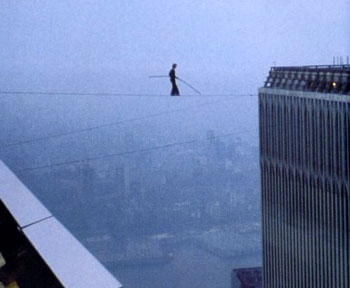
Which brings me to one of the catalysts, which in turn got me thinking. One of my favourite films, Man on Wire, was on TV a week or so ago. Watching it, spellbound (for those of you unfamiliar with it, this a documentary about Philippe Petit, a tightrope walker who, with a few co-conspirators, in 1974 illicitly rigged a cable between the twin towers of the World Trade Centre, and proceeded to walk across - and then back, and back again, stopping to lie down, to look down, to kneel to the dawn, almost dancing as he played dare with the police waiting to arrest him at the other end), one line struck me. One of the first things the arresting officers asked him was "why?" Petit's response was one of those lightbulb moments. Odd, because it's a common question - we all think of those "why?" "because" exchanges about climbing Everest. But Petit's response wasn't "because", it was to shake his head and despair that after such a beautiful moment the officer had deflated it with something as banal as a question.

For me, that exchange is a perfect commentary on the cultural life.

It also set me thinking (natinal cultural stereotyoe alert!). One of the things I'm researching for a new book is parkour. Don't worry, I'm not actually doing it, rather I'm researching those who do, and the philosophy behind it.

Parkour (the art of movng through a space continually forward by finding ways for your body - and mind - to overcome obstacles - you may not realise it but you saw it in that BBC ad a few years ago that you thought was all stunts and mats and tricks but wasn't) was given its shape and identity by David Belle (that's him in the video), who developed it with his friends in Fecamp, in France. And then I thought about the incredible "spiderman" Alain Robert. And the stereotyping part of my brain took hold of the fact that the three people I was thinking about were French. Now, we're used to people talking about literature and philosophy in France and their place in French life, but maybe it's not really Bernard Henri Levy and Michel Houellebecq we should think of but the likes of Belle, Petit, and Robert.

Petit's words have blended sowly into that mantra over the last few days - the need to do something spectacular, beautiful, memorable and, possibly equally important, inexplicable. But for those of us whose bodies are closer to Henri Levy than Belle, and dabble in creativity with our minds, what does that mean? "Be spectacular" - the rest, as I said at the start, is just the unpacking, and yet absolutely everything is in that unpacking. In focusing on a thing - a single, spectacular, beautiful thing, and moving always and only towards it. Sometimes it seems to me as though the thing is life itself - but life, as my last two collections have been written to demonstrate, is nothing without content, without relentless energy and celebration. At other times I think asking the question at all is the problem - a sign of my Englishness? - and yet these remarkable characters don't have the aimlessness of people who haven't honed down their goal to absolute concreteness in the  way we imagine when we think of a lack of questionning.

Then I thought on, of my recent conversations with friends who know far more than me about zen, Trevor Barton and Viv Tuffnell, and I wondered if they would tell me that the key is not to question but to "know", whcih made me think "but I don't know". But maybe the answer is that it is the questionning - of ourselves, our lives, our world, that stops us from "know"ing what we have to do, and then giving ourselves to doing it. Maybe the answer lies in learning to know oneself well enough that one does not have to question - which sounds a lot like what I have said about confessional art and stripping everything to your most basic truth. I'm still not there, but maybe I'm startig to learn which questions not to ask. The fundaental mantra seems unchallengable, though, for us as artists:

"be spectacular"


Thursday, 24 May 2012

Self-publishers fail to earn a fortune shock!

The Taleist today published the results of its survey into self-published authors' earnings and their habits. They asked 1007 authors 61 questions, which mkes it undoubtedly an important event. The headline figure is that self-published authors earn $10,000 a year from their books on average (£6375) whilst half earn under $500. The media is already buzzing with the seeming negativity of this - though in reality it's hardly quantum leaps off the mark of the Society of Authors figures for published authors (£16k mean £4k median).

There are some fairly bland observations - people who write romance earn most by genre, people who write literary fiction don't earn much, you do better if you hire an editor, but the report will no doubt go viral, and for me that is worrying because - whilst it can hardly but wear its unscientific colours on its sleeve, it seems to me much more a "how to" guide than a state of play survey, and that means authors are going to jump on it and maybe overlook many of its gaping holes - by not being exhaustive and rigorous, it's impossible to use the information in this report as a definitive how-to, because it fails to analyze what may be other central contributing factors to the bestsellers' success (in addition, that is, to, DUH, how good the book is as a representative of its type, which I've not seen mentioned in anny of teh coverage so far!!!!)


In addition to the survey size, I can't find the original post asking for respondents on the Taliest website, but the fact the actual report being charged-for at £3.30 a pop raises questions - I'd like to know whether it was made clear to participants if they were undertaling the survey as part of a commercial enterprise, for example. The purpose seems to have been mainly to produce a "secrets of bestselling authors" document rather than a state of play one, as I've mentioned. No problem in that, but this angle and the commercial aspect combined (one can't help but compare it to John Locke's "How I sold a million" only "how people sell millions") need to be taken into account before people simply red the results off the page as if they were instructions.

That said, the conclusions seem sound, if somewhat obvious - romance sells best, you sell more when you use an editor and cover designer. As how-to goes, though, authors would probably be better served by the 99 cents for Locke's book. What we really need for a definitive "secrets of success" guide is a survey that goes right into the detail of metadata, for example. At one of the events at London Book Fair, an Amazon representative said the single best piece of advice he'd give an author trying to make sales on Amazon was get their metadata right. It would be great to take some cross sections within genres and see some segmented data based on review stats, metadata, price, inclusion in charts, promotional sites used (one thing authors desperately need research on is just how effective in the long run paid-for promotions on sites like Kindle Nation Daily are, with control groups and longitudinal data over several years cross-compared with the dates of other major promotions such as Amazon newsletters and sales containing books in the same genre so authors can see the effect of timing their promotion).

One thing that sounds very familiar from listening to self-publishing debates but seems to me to be utterly contentless:
It shouldn't have surprised me that 75% of the royalty pie is going to 10% of authors: that's life in many industries. If I'm being honest, though, I'd hoped self-publishing might be a bit more democratic
What is that supposed to mean? That they hoped in a self-publishing world everyone would sell exactly the same amount of books? (never going to happen) That they hoped everyone would appear in the same marketplace? (they do) That they hoped sales would be less affected by variables reflective of a profesisonal attitude like getting in a cover designer and editor? (maybe they hoped it but I'm sure readers didn't) That they hoped sales would be more bunched with less outlier-skewing? (they are but the survey is too small and self-selecting to reflect that)

This report is interesting and I would advise athors to read the coverage with interest. Worth £3.30? Maybe, but only if you go in with eyes wide open about what you can and can't expect to get out of it.

And a note of scepticism - many of the questions I want to ask, even ones I've raised here, would no doubt be answered by thereport's authors with the line if you buy the report, you'll find out" - and that most definitely is not the mark of research done for the sake of information.