(my new collection of poetry is available for Kindle & Kindle app here for £1)
The inscription at the front of my book (life:) razorblades included says simply
"be spectacular and die living"
That's still about as much as needs to be said on the subject of either life or art. The rest, as it were, is just unpacking. It's so incredibly difficult to keep it plastered to the inside of our eyelids as we wade through life, and, to get more specific, as writers setting out "to be published" or "to sell books" or even "to connect with readers". The line itself is something I've become a dab hand at churning out but singularly bad at reflecting upon and aspiring to. My recent lift in spirits and creative direction has been largely a result of thinking about that simple mantra.
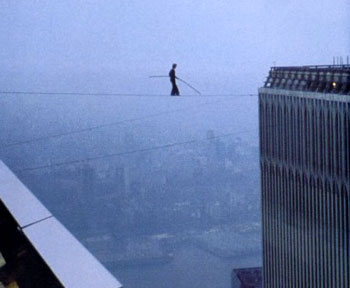
Which brings me to one of the catalysts, which in turn got me thinking. One of my favourite films, Man on Wire, was on TV a week or so ago. Watching it, spellbound (for those of you unfamiliar with it, this a documentary about Philippe Petit, a tightrope walker who, with a few co-conspirators, in 1974 illicitly rigged a cable between the twin towers of the World Trade Centre, and proceeded to walk across - and then back, and back again, stopping to lie down, to look down, to kneel to the dawn, almost dancing as he played dare with the police waiting to arrest him at the other end), one line struck me. One of the first things the arresting officers asked him was "why?" Petit's response was one of those lightbulb moments. Odd, because it's a common question - we all think of those "why?" "because" exchanges about climbing Everest. But Petit's response wasn't "because", it was to shake his head and despair that after such a beautiful moment the officer had deflated it with something as banal as a question.
For me, that exchange is a perfect commentary on the cultural life.
It also set me thinking (natinal cultural stereotyoe alert!). One of the things I'm researching for a new book is parkour. Don't worry, I'm not actually doing it, rather I'm researching those who do, and the philosophy behind it.
Parkour (the art of movng through a space continually forward by finding ways for your body - and mind - to overcome obstacles - you may not realise it but you saw it in that BBC ad a few years ago that you thought was all stunts and mats and tricks but wasn't) was given its shape and identity by David Belle (that's him in the video), who developed it with his friends in Fecamp, in France. And then I thought about the incredible "spiderman" Alain Robert. And the stereotyping part of my brain took hold of the fact that the three people I was thinking about were French. Now, we're used to people talking about literature and philosophy in France and their place in French life, but maybe it's not really Bernard Henri Levy and Michel Houellebecq we should think of but the likes of Belle, Petit, and Robert.
Petit's words have blended sowly into that mantra over the last few days - the need to do something spectacular, beautiful, memorable and, possibly equally important, inexplicable. But for those of us whose bodies are closer to Henri Levy than Belle, and dabble in creativity with our minds, what does that mean? "Be spectacular" - the rest, as I said at the start, is just the unpacking, and yet absolutely everything is in that unpacking. In focusing on a thing - a single, spectacular, beautiful thing, and moving always and only towards it. Sometimes it seems to me as though the thing is life itself - but life, as my last two collections have been written to demonstrate, is nothing without content, without relentless energy and celebration. At other times I think asking the question at all is the problem - a sign of my Englishness? - and yet these remarkable characters don't have the aimlessness of people who haven't honed down their goal to absolute concreteness in the way we imagine when we think of a lack of questionning.
Then I thought on, of my recent conversations with friends who know far more than me about zen, Trevor Barton and Viv Tuffnell, and I wondered if they would tell me that the key is not to question but to "know", whcih made me think "but I don't know". But maybe the answer is that it is the questionning - of ourselves, our lives, our world, that stops us from "know"ing what we have to do, and then giving ourselves to doing it. Maybe the answer lies in learning to know oneself well enough that one does not have to question - which sounds a lot like what I have said about confessional art and stripping everything to your most basic truth. I'm still not there, but maybe I'm startig to learn which questions not to ask. The fundaental mantra seems unchallengable, though, for us as artists:
"be spectacular"
here be musings. Books, gigs, and links at http://danholloway.wordpress.com
Friday, 25 May 2012
Thursday, 24 May 2012
Self-publishers fail to earn a fortune shock!
The Taleist today published the results of its survey into self-published authors' earnings and their habits. They asked 1007 authors 61 questions, which mkes it undoubtedly an important event. The headline figure is that self-published authors earn $10,000 a year from their books on average (£6375) whilst half earn under $500. The media is already buzzing with the seeming negativity of this - though in reality it's hardly quantum leaps off the mark of the Society of Authors figures for published authors (£16k mean £4k median).
There are some fairly bland observations - people who write romance earn most by genre, people who write literary fiction don't earn much, you do better if you hire an editor, but the report will no doubt go viral, and for me that is worrying because - whilst it can hardly but wear its unscientific colours on its sleeve, it seems to me much more a "how to" guide than a state of play survey, and that means authors are going to jump on it and maybe overlook many of its gaping holes - by not being exhaustive and rigorous, it's impossible to use the information in this report as a definitive how-to, because it fails to analyze what may be other central contributing factors to the bestsellers' success (in addition, that is, to, DUH, how good the book is as a representative of its type, which I've not seen mentioned in anny of teh coverage so far!!!!)
Tuesday, 22 May 2012
Action Points
On Sunday months of unease and a moment of revelation
culminated in a rather long and introspective post about the way I’ve been
using my time, and the changes I need to introduce to keep my sanity and my
energy and passion for promoting the love of words. I have been truly moved by
the response but I’m aware that I left things rather vague, which isn’t really
very helpful of me. So I wanted this post to be the concrete cousin of Sunday’s,
outlining tersely and attentively what I do want to spend my time promoting.
What I discovered when I sat down to think about it was that actually nothing
has changed since I drew up all those early manifestos – the only thing that’s
changed is that I’ve allowed myself to get sidetracked and spread too thin, so
this is little more than a reiteration and reaffirmation of those ideals that
matter most to me
- The New Libertines show. This has evolved into a wonderful live show, and remained true to the original creative manifesto:
“The New Libertine movement, if it can be
labelled a movement, stands for human experience in its glorious, messy,
complex entirity, and stands against everything that is blank, bleak, and
brutal, one dimensional or slick in contemporary culture, especially current
literary culture. With roots that spread to burlesque, Beat, fin de siecle
France and ecstatic mystics before slapping its influences around the face with
a knuckle-dusting of postmodern wit and Modernist anger, New Libertinism is a
celebration of light in dark corners, desire in the face of boredom, despair hidden beneath
the underskirts of affluence – of everything it means to be human.
Writing that serves up the whole of life, in
the smallest microcosms maybe, single truths told in single voices, but told in
the full – the ugly and the beautiful; the hopeful and the despairing; the
angry and the aspiring; that wrings art, words, life itself until they
offer up every last secret, every hidden pain, every unexpected and delightful
pleasure; that gives life in the full. Free from judgement. Free from taboo. Free
from pretence”
I want to take the show on the
road and do 5 or 6 shows a year, maybe include some festivals or a proper mini
tour, but develop the brand and its USP that combines the above artistic
statement with the format of lots of short sharp sets that have no headline and
no support. In order to keep building the audience this means I’m going to have
to keep the focus of the acts I can include very distilled. I hope people will understand.
The result will be fewer spaces available but, I hope, a much bigger gulp of
air for those who work in that area – and of course I will happily tweet out
about everyone else I love working in different areas.
- Overgrounding the underground. This has always been the central priority at eight cuts gallery, as voiced in our manifesto:
“there is writing out there that will blow your
mind. and you have no idea it’s there at all.
eight cuts exists to champion extraordinary
literature from people you may never have been given the chance to encounter,
be it a single poem, a performance or a body of novels
eight cuts is a doorway to a world you heard is
there.
a world intimated at in blog comments and tweets
a world alluded to in magazines
a world a shadow of a shadow of which is hinted
at in newspaper and magazine articles
a world you’ve probably been told is meaningless,
scary, junked-up, trashy, bloated, angry, wannabe
our world
we are rats
we live in our own space, build our own
communities, societies, foundation myths and bodies of work.
we share some of your doorways, and sometimes you
will see the traces we leave behind. traces like this. often they are strange,
unfamiliar, and consequently seem frightening, but they are doorways onto a
whole world that exists, fully formed, in parallel with yours.
for too long we have been expected to push at
these doors, and gaze around them in wonder and admiration, dreaming, cap in
hand, of one day entering the world beyond them. we think maybe it’s time for
us to offer an invitation the other way.
go on. push, and see what exists on the other
side of the door. those traces you see on blogs and underpasses, left behind in
railway carriages and in strange marks on walls and pavements and facebook
updates. they are tips, and traces, but of what? of something remarkable and
fantastic.”
I want to keep bringing the very best of this
world to people’s attention.
- Making a pain in the ass of myself in calling the media to account when it whitewashes over whole swathes of literature like it doesn’t exist. That means championing self-publishing to papers, competitions, and festivals. It means championing genuinely daring and original self-publishing within that discussion. It means championing poetry, and spoken word within the discussion of poetry. It means championing the possibilities of technology not for selling stuff or distributing stuff but for doing startling and original things.
- Campaigning for the true democratisation of art and removal of the hidden boundaries – in particular, not letting up when it comes to reminding people of the digital divide; pointing out the implicit exclusions in the traditional publishing model and campaigning for wider access to more material by a wider body of writers from more groups within society; campaigning on mental health issues in the arts.
- Flying the flag artistically against the myth of the death of the author and for the confessional in art – be that theoretically, by championing confessional work I love, or through my own work.
Sunday, 20 May 2012
Turning Points
EDITED TO ADD - it only just dawned on me the catalyst for this thought process was this incredible, moving, insightful post from Sophie at Little Fish, an Oxford band whose integrity and ethos have been inspirational for years. Thank you to her for making me think. Do go and read what she has to say - it's important, and she's so much more eloquent than me.
I started 2012 in a strange and rather unhappy place, and I’ve been there for most of the year since. I was in such a deep rut with my writing that I swore off doing any promotion of any kind for the year and declared 2012 a year when I’d play around creatively and see what happened . That still didn’t work.
Yes, I was producing some new material for the first time in
several months, but the same gnawing doubts and insecurities were there, and
they were being exacerbated by increasingly poor general mental health that
meant I was becoming more insular, avoiding social situations, getting tetchy
and distant.
It feels as though I finally turned a corner a little over a
week ago. It came from a convergence of several very dark places that forced me
to look right in the face at what was really eating at me, and what I really
wanted. Undoubtedly the bulk of what I needed to come to terms with was that I
was displacing an awful lot of feelings around my mum’s health struggles. Being
able to get that straight with someone as wise and supportive as my wife
instantly cleared my head, letting me feel the emotions that needed feeling in
the directions they needed pointing at and clearing out a whole lot of other
areas that weren’t really their place.
That still left a lot of creative issues to come to terms
with, though, and doing so has been hard, because it has involved reopening a
lot of very old wounds and resentments. It’s also been hard because some of the
things that have been eating away at my enjoyment of all things creative are
things I don’t like about myself – most of which come under the heading of
stretching myself too thin. Specifically, saying yes to too many things that,
whilst important, and whilst for people I love and respect, aren’t things that
have anything to do with what I’m best at or what I really want to achieve. I
love promoting people, and putting on shows to promote amazing writing, for
example, but for a long time too many shows have been less focussed than they
should have been because I’ve not selected what was best for the show – the end
result of which is that no one gets the full benefit they should have done.
Like wise I receive requests to read work on a very regular basis and it’s
something I try desperately to do but for well over a year it’s come almost
completely at the expense of any time to do my own writing. The problem I have
is that even thinking these things makes me feel like a revolting human being –
I have struggled for much of my life to understand how people who do their own
thing when there are other people they could be doing things for are able to
look in the mirror. The very idea of focusing on my own work leaves me with a
whiff of self-disgust.
This isn’t intended as a piece of self-absorptive
indulgence, but I hope the process by which I’ve turned the corner, the places
I’ve had to go and things I’ve had to think through, will strike chords with
others who’ve reached a similar sticking point in their creativity. So without
going into too much detail, the deep dissatisfaction I’ve been shielding myself
from goes back to my breakdown in 2000, which put paid to the academic career
I’d wanted pretty much all my life and, if I’m honest, still do. All my
writing-related feelings of anxiety and deep unworthiness go back to that.
But they also go beyond, back to schooldays as, as my
wonderful friend Michele Brenton puts it, the fat kid with the sweeties. That
was me, trying to figure any strategy not to get seven strips peeled off me.
And then at university I learned that constantly doing more and more was at
least a way of maintaining some kind of social contact with people I knew would
never speak to me otherwise. Which made me all kinds of conflicted, because the
desire to do what I could was real, and yet any help I gave I ended up
resenting, because of the feeling that friendship, acceptance shouldn’t depend
on usefulness.
Spooling forward, this is exactly the kind of conflict at
the heart of my writing life – a desperate desire to help in any way I can,
paired with fat kid with sweets syndrome, the knowledge that the moment I start
saying no to requests any kind of meaningful involvement in the writerly
community will end. Which means I end up resenting many things I do do.
What I’ve failed to see is what I have a feeling is a
shortcome many of us share, and one I’ve written about before but singularly
failed to take proper notice of. None of this is a zero sum game. I can’t do my
best for what I believe in most – which is to enthuse as many people as
possible with a passion for the most amazing work that’s out there, and to fire
people up with a passion to let their voices be heard – without reining back
and focusing. I can’t do everything. Neither can I do the things I do focus on
to the best of my ability if I’m not balanced and centered, and working with
the attention it deserves on my own stuff. And if that means doors that have
been open to me are closed, I have to accept that, and let my work stand on its
own, and make it the very best I can, and do that alongside giving my all to
those things I have the knowledge and energy to give my all to, and just hope
people understand.
So here’s what that means
First, I am only going to work on writing I believe in. I’ve
already taken The Company of Fellows off Amazon. I’m proud of it but it’s a
long way from my best work, and it’s not something I can see in my creative
future. It’s been hanging around me like a bit of a millstone and I’m relieved
it’s not there any more, however much harder that makes it to get taken notice
of.
Second, I’m going to be a lot more focused about the shows I
organise. I spread myself way too thin last year. I want to take the New
Libertines format and make it something really successful, putting on shows
across the country 5 or 6 times a year, and focusing on those shows
publicity-wise, building to a stage where we end up on festival programmes. I
would dearly love to do more shows that other people put on, and dearly dearly
love to build up to some slots as a poet on the bill, but that will rely on
taking the leap of faith to trust my performances to stand for themselves and
the work to bring them up to scratch
Third, I am sure I made the right decision to stop
publishing other people’s work. It took too much out of me emotionally, almost
sent me to a breakdown on more than one occasion. My finances have also changed
since I started – I just can’t put the resource into promotion I need to, and
there is so much guilt and conflict I just can’t do it. What I will continue to
do, and do more of, is promote people through the eight cuts website and in any
way I can online.
Fourth, I’m going to throw myself into my own writing, both
the writing and the performing of it. And I’m going to promote it, gently and
courteously, but promote it nonetheless because I’m determined only to put out
there things I’m really proud of, starting with the new poetry collection, Last
Man Out of Eden, of which I’m incredibly proud.
Fifth, I will continue to
campaign for greater recognition of self-published writers at festivals and in
the media, and will work with groups like the Alliance of Independent Authors
to further those campaigns – and I will use any platform I have or can develop
to make sure that when self-publishing is talked about, it’s not just sales or
the so-called successes but the content of books, and the wonderful experimental
delights that self-publishing is made for. I’ll devote more energy than ever to
the eight cuts mission statement of “overgrounding the underground”. I’ll
promote the profile of poetry, and performance poetry within that, and try to
bring amazing things to new readers.
Sixth and finally, I want to work on the blog on my main website to make it a more helpful, informative place, focusing on each of the five points above.
So there we have it – self-reflective and self-indulgent,
but a series of important realisations about the balance of a life that
combines writing, advising, and cultural campaigning that I hope will not only
explain but encourage.
And finally finally and most of all, a huge thanks to all my wonderful friends and their patience through my grumpy recent past :)
Tuesday, 15 May 2012
Free Flash
Tomorrow is National Flash Fiction Day. Which brings much cause for celebration. First off, this is the first
time ever we’ve celebrated this marvellous form as a nation – the Arts Council
have even got behind it. Second, tonight, as part of the shindig, we’re holdinga flash slam in Oxford,
combining the worlds of poetry slam and flash fiction
as twelve of the UK’s finest practitioners battle it out, reading their
stuff
in front of an audience and celeb judge, the short fiction legend Tania
Hershman. If you’re anywhere near Oxford,
do come along to what will be a truly wonderful evening. And if you’re
not,
please do check out what’s going on in your area. Third, to celebrate
National Flash Fiction Day, my two short fiction collections are free
for today and tomorrow:
(life:) razorblades included contains some award-winning short stories and poems with some adult content. Free in the UK and elsewhere
Ode to Jouissance also has some award-winning shorts of a lyrical nature, exploring questions of ageing and identity in 20th century Europe. Free in the UK and elsewhere
There's a full list of all the free flash fiction downloads for National Flash Fiction Day here
Tuesday, 1 May 2012
Last Man Out of Eden - CD & pamphlet
So I've finally got some new work to show for myself. Last Man Out of Eden is a CD and pamphlet of performance pieces out on June 12th (which, coincidentally, is the date of the Hammer and Tongue final). It's a collection of poems about hope in the face of disappointment, with a
lyrical confessional style that takes in equal amounts from
Ferlinghetti, Tracey Emin, and Patti Smith’s Just Kids. These poems celebrate the healing powers of time, non-violence, and remembrance but above all carry a simple message:
Celebrate the lives of those you love because one day they won’t be with you any longer and you’ll be left writing poetry about how you wish you’d loved them more.
And here's the bit where I really need your help. I'll be recording the poems for the CD live and I need an audience. It will be at 7.30 on Friday June 8th at (of course) The Albion Beatnik Bookstore. If you think you can sit and whoop up some raucous applause through a set of 9 poems (it'll take 30-35 minutes) whilst being plied with wine, please come along!
Monday, 2 April 2012
Poetry video: We Were Making Fairytales
…performed at ARTournament in Gloucester on April 2nd. Part of a new project about creative friendships inspired by Patti Smith’s Just Kids, Katelan Foisy’s Blood and Pudding, and a dear dear friend and collaborator of Katelan’s and mine.
Subscribe to:
Posts (Atom)


That said, the conclusions seem sound, if somewhat obvious - romance sells best, you sell more when you use an editor and cover designer. As how-to goes, though, authors would probably be better served by the 99 cents for Locke's book. What we really need for a definitive "secrets of success" guide is a survey that goes right into the detail of metadata, for example. At one of the events at London Book Fair, an Amazon representative said the single best piece of advice he'd give an author trying to make sales on Amazon was get their metadata right. It would be great to take some cross sections within genres and see some segmented data based on review stats, metadata, price, inclusion in charts, promotional sites used (one thing authors desperately need research on is just how effective in the long run paid-for promotions on sites like Kindle Nation Daily are, with control groups and longitudinal data over several years cross-compared with the dates of other major promotions such as Amazon newsletters and sales containing books in the same genre so authors can see the effect of timing their promotion).
One thing that sounds very familiar from listening to self-publishing debates but seems to me to be utterly contentless:
What is that supposed to mean? That they hoped in a self-publishing world everyone would sell exactly the same amount of books? (never going to happen) That they hoped everyone would appear in the same marketplace? (they do) That they hoped sales would be less affected by variables reflective of a profesisonal attitude like getting in a cover designer and editor? (maybe they hoped it but I'm sure readers didn't) That they hoped sales would be more bunched with less outlier-skewing? (they are but the survey is too small and self-selecting to reflect that)
This report is interesting and I would advise athors to read the coverage with interest. Worth £3.30? Maybe, but only if you go in with eyes wide open about what you can and can't expect to get out of it.
And a note of scepticism - many of the questions I want to ask, even ones I've raised here, would no doubt be answered by thereport's authors with the line if you buy the report, you'll find out" - and that most definitely is not the mark of research done for the sake of information.